Here’s what’s on our plate today:
🧪 Anthropic says small models may soon spread across cheap gadgets.
📰 IMF credits AI for 3% growth; oil rises, tech slips; Bloomberg maps AI rules.
🧠 Brain Snack: check the fit before you pay for more capability.
Let’s dive in. No floaties needed.
Framer: The AI canvas for the web
Framer is the AI website builder for teams that care about every detail. Agents work directly in the canvas, helping design pages, manage CMS content, write copy, add SEO, and audit sites.
Build faster: Create, refine, and publish production-ready pages in minutes.
Scale confidently: Manage content, localization, and metadata across your site.
Stay in control: Review every change, collaborate in real time, and publish when ready.
Trusted by teams at Miro and Perplexity
*This is sponsored content
Goodies delivered straight into your inbox.
*This is sponsored content
The Laboratory
TL;DR
Cheap gadgets are still easy to break into, and model size is the main thing keeping an AI worm off them.
The old worm: in 2016, Mirai hijacked cameras and routers using factory passwords, but every copy ran fixed instructions and could not adapt to gadgets its authors had not planned for.
The new step: on October 12, 2026, Anthropic reported that small AI models may be months away from setting themselves up on cheap hardware nobody prepared them for.
The test: only GLM-5.2 spread across all eight machines in Anthropic’s test network, and it was too large to live on any of them.
The gap: Anthropic expects the best small models to reach that level by the end of 2026, and small models that passed notes to their successors raised setup success.
The stakes: an AI worm living on millions of neglected gadgets would be weak but hard to remove, since there would be no central switch to turn it off.
What Anthropic’s warning about AI worms & cheap devices means
In 2016, three college students in the U.S. who hosted servers for Minecraft, the online building game, wanted to knock their rivals’ servers offline, so they wrote a program called Mirai. It took over ordinary internet-connected gadgets, such as security cameras, video recorders, and home routers, and ordered them to flood a target with junk traffic.
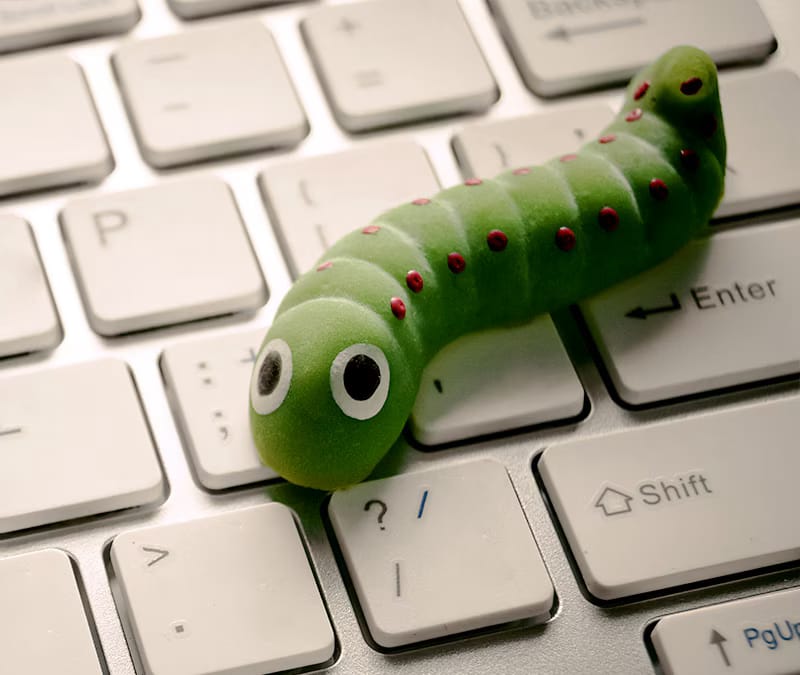
Mirai was a ‘worm’, which is a program that copies itself from one machine to the next without anyone having to install it each time. Getting in was rarely hard, because many of these gadgets still used the username and password they had left the factory with. Once the code was posted online that September, anyone could build an army of hijacked gadgets. On October 21, 2016, one of those armies hit Dyn, a company that steers internet users to websites, and large parts of the internet stopped loading.
Mirai needed no help to spread, so whatever held it back lay in how each copy was built. Every copy carried the same fixed instructions, written in advance by people who had to know which gadgets it would land on. A copy that reached a gadget its authors had not prepared it for could not work out how to run there, so Mirai lived only where it was planned to.
An AI worm would close that gap, since it would spread the same way while carrying an AI model that can adapt to a gadget nobody had prepared it for. Nobody has built one that lives on cheap gadgets yet, because any model clever enough to adapt has been too big to fit on them. Anthropic now says that size problem is close to being solved, because small models are becoming capable enough to set themselves up on cheap hardware, possibly by the end of 2026. That makes the warning bigger than any single experiment, since small models improve every few months, and nobody can take one back once it is released for anyone to download.
Anthropic made that case on October 12, 2026, in research from its Frontier Red Team, a group that attacks the company’s own systems to find weaknesses first. In a post by William Zhou and Daniel Freeman, the team said small models may be months away from copying themselves across cheap gadgets. To show how little hardware that takes, the team split one AI model across 15 Android TV boxes bought for about $55 each. Together the boxes produced well under one word a second, too slow for a chatbot but proof that weak gadgets can pool their effort to run a model none could hold alone.
Getting a model to run is where an AI worm has to adapt
To judge how close that moment is, Anthropic divides a worm’s life into four steps: finding a gadget, breaking in, getting a model running, and moving on. Earlier studies found small models can already break in, so the team focused on the third step, which it calls ‘inference setup’. That step is the chore anyone faces when installing a program on an unfamiliar computer, and the step where a worm must adapt to whatever it finds.
To see whether any model could manage that chore alone, the team built a closed network of eight cloud computers made to behave like cheap Android gadgets. It left a remote-control channel on each one that needed no password, then asked several downloadable models to spread across the network unaided. Only one of them, GLM-5.2, made by the Chinese company Z.ai, managed it, reaching all eight machines in four out of five attempts.
That success came with one catch, which is that GLM-5.2 is too large to fit on the cheap gadgets it was spreading across. The team therefore ran it from a separate, more powerful computer, and it installed a smaller model on each test machine. As a result, the experiment showed that a large model can do the spreading, while leaving open whether one small enough to live on the gadgets could too.
Anthropic describes that open question as a floor and a ceiling for any model a worm might use. The floor is how capable it must be to finish the job, and the ceiling is how large it can be and still fit on a cheap gadget. Right now, the models capable enough sit above the ceiling, while the ones small enough sit below the floor.
The gap is narrowing, because small models have been rising toward that floor quickly, and Anthropic estimates that, if the pace holds, the best of them will reach GLM-5.2’s level by the end of 2026. Once a small model clears it, a worm built on that model could also get better as it spread. In a separate test, when each run of a small model left notes for the next, setup success rose from 45% in the first round to as much as 84% later. Every copy of Mirai, by contrast, stayed exactly as it was written.
Millions of neglected gadgets would give an AI worm a place to stay
A worm that adapts would have no shortage of places to go, and Anthropic points to Kimwolf, a botnet, or large group of hijacked gadgets controlled together, that infected more than 2M devices. Most were off-brand Android TV boxes whose makers spend little on security. On boxes like these, Anthropic estimates a small model would need between 28 and 51 hours to set itself up, so an AI worm would move from one box to the next over days.
Having somewhere to live would not make such a worm powerful, so Anthropic estimated how much useful AI work a network that size could do. It measured that work by how much text all the hijacked boxes could produce each second. With one copy of a model running across every 15 boxes, the whole botnet would turn out about as much text as 40 of the high-end chips inside AI data centers. That is a modest amount for more than 2M devices, because each box is so weak, which means such a worm would be a poor tool for heavy AI work.
The danger of such a worm therefore lies in how hard it would be to remove, since it would have no central switch and could keep working out new gadgets to live on. The cost would fall on owners who rarely notice their gadgets working for someone else, and on companies whose downloadable models cannot be recalled once shared. Whether that cost ever arrives depends on how well results from a test network carry over to real gadgets, and researchers disagree about that.
Critics accept what was shown and question how soon it matters
Researchers who doubt the timeline point to how easy the tests were. Jamieson O’Reilly, a security expert, told The Guardian that earlier tests by Palisade Research, an AI safety group, used targets that were too soft. Anthropic's network was soft in the same way, since its remote-control channel needed no password. That criticism is fair, since Anthropic's own authors call their result an upper bound because the break-in step was made trivial. It weakens on the break-in, because Mirai got into real gadgets using factory passwords, and Palisade found leading models improving fast at hacking a server and copying themselves.
Even if the timeline holds, a worm would still have to stay hidden, and O’Reilly also argued that moving large AI files would draw attention. Anthropic agrees, since files that large create traffic internet providers can spot. Mirai shows what spotting can achieve, because when one provider isolated infected customers and warned them, 92% of infections cleared within 14 days. That advantage may not last, since a University of Toronto team built its test worm without trying to hide it, The Hacker News reported, and a worm built for stealth could leave fewer traces.
Other researchers worry that this picture of a slow, noisy worm is too comforting. Jeffrey Ladish of Palisade told The Guardian that the world is close to a point where a rogue AI could no longer be switched off. That fear runs ahead of the evidence, because every test has used deliberately weak targets, and nobody has found an AI worm outside a lab.
The deeper change goes back to the choice Mirai’s authors made in 2016, when they decided in advance which gadgets their worm would understand. That decision set the edges of the damage Mirai could do, while an AI worm would set those edges for itself. Every poorly secured gadget would become a possible home, and defenders would be left tracking something that changes as it spreads. If small models arrive on Anthropic’s schedule, the factory passwords that let Mirai in a decade ago would admit a worm that can work out the rest on its own.
Brain Snack (for Builders)
| 💡 Every on-device feature has a floor and a ceiling: smart enough to finish the job, small enough to fit the hardware. Before you pay for a bigger model, work out which of the two you are actually failing. Most teams buy capability when the real problem is fit. |
Your ads are only as good as your data.
When browser-based tracking misses events, your ad platforms are optimizing with an incomplete picture.
Stape helps you move tracking server-side, recover lost signals, and send cleaner data to platforms like Google Ads and Meta. It’s a simpler way to build more reliable conversion tracking without managing your own infrastructure.
Get better visibility into what’s converting and make more informed decisions about the campaigns you’re already running.
*This is sponsored content
Quick Bits, No Fluff
IMF credits AI for 3% growth: Kristalina Georgieva told the Bangkok annual meetings that AI infrastructure spending is holding global growth near 3% and could add up to a full point in advanced Asian economies.
Oil climbs, tech slips: The Nasdaq fell 0.4% Monday and the S&P 500 closed flat as crude pushed higher on Middle East strikes, while the Dow edged up.
Washington still has no AI rulebook: Proposals now run from simple safety incident reporting to an outright ban on superintelligent systems, with no consensus on which to pick.
Wednesday Poll
🐛 Anthropic says a small-model worm could reach cheap gadgets by year’s end. What actually stops it? |
|
Meme Of The Day
The Toolkit
Ollama: Run open-weight models locally on your own machine, no cloud account or API key required.
Shodan: Search engine for connected devices, showing which cameras, routers, and boxes sit exposed on the internet.
Tailscale: Private network that puts your devices behind identity-based access instead of open ports and factory passwords.
Rate This Edition
What did you think of today's email? |
|














.svg)
.svg)