How T:0 Is Turning Bookkeeping Into Infrastructure With Lance Co Ting Keh
Welcome to Revenge of the Nerds. We’re skipping the hype and going straight to the builders. In this edition, we talked about:
Lance's last startup almost missed its Airwallex exit because his own books were a mess. T:0 is the fix he wished he'd had.
When T:0 doesn't know what a transaction is, it asks instead of guessing. A $20k wire with no source becomes an inbox question you can answer in plain English.
The AI writes the accounting rules, but a deterministic system applies them to the ledger, so nothing in your P&L gets made up.
Let’s dive in. No floaties needed…
We build the tasks your model fails.
PhD researchers and domain experts author verified, containerized tasks in the Terminal-Bench and GDPval mold, spanning coding, finance, accounting, engineering, and more.
On our harder tasks, frontier models score 0 out of 5.
*This is sponsored content
Make the most of everyone you meet
You have a great conversation in the coffee line… then it ends. Nobody swapped details and all you've got is a first name.
Blinq helps you share who you are and remember who you meet, planned or unplanned.
Share your personalized digital business card in seconds. They get all your details (no app needed).
Capture contacts, and remember what you talked about with AI Notetaker.
No more "I'll reach out on LinkedIn."
Start for free, under 2 minutes to set up.
*This is sponsored content
Revenge of the Nerds
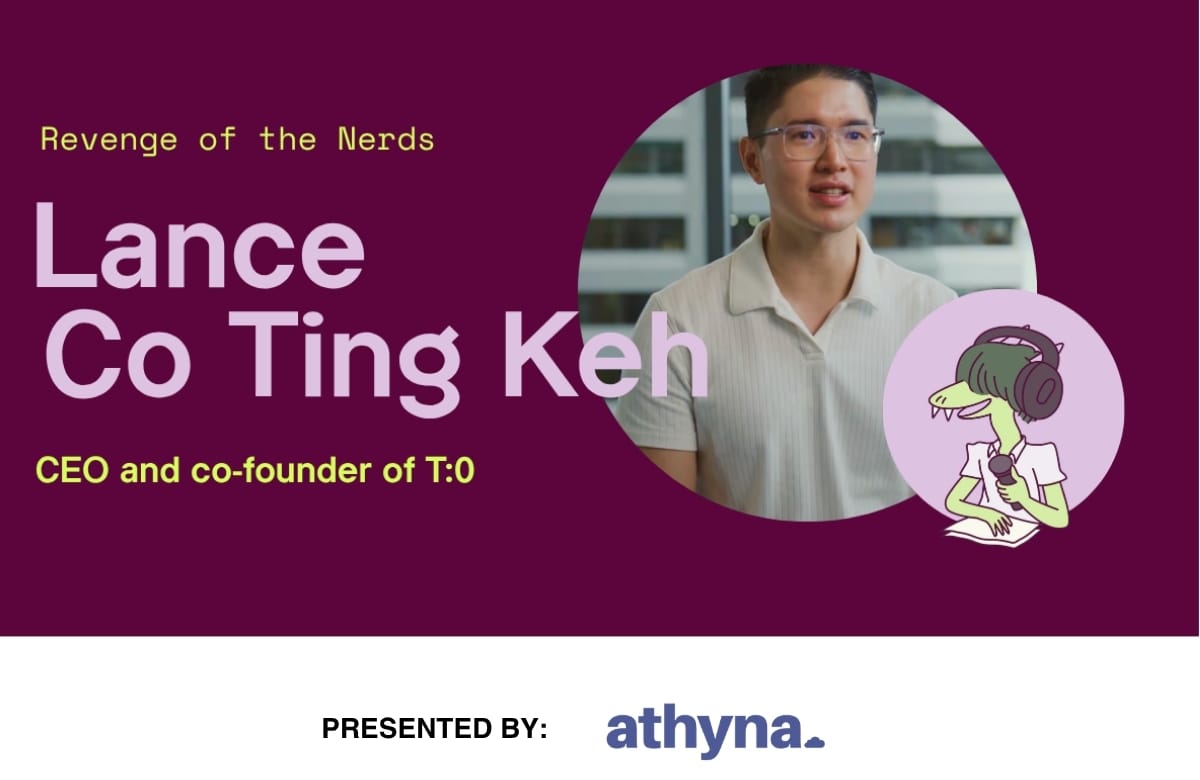
Lance Co Ting Keh, CEO & Co-founder of T:0
Lance Co Ting Keh has done what he calls the Silicon Valley tour of duty. He helped start the machine learning team at Box ahead of its 2015 IPO, was the second engineer at Cresta before it hit a $1.6B valuation, and led engineering for two teams at X, Alphabet's moonshot factory, working on AI drug discovery and computer vision. In 2023, he founded OpenPay, a subscription-billing startup he bootstrapped to seven figures of revenue. Airwallex bought it in September 2025, and the deal almost fell through because his own books weren't in order. That's the origin story of T:0, the AI-native accounting platform Airwallex incubated as a subsidiary, announced alongside its $320M Series H at an $11B valuation in June 2026, and opened to every US startup on September 1, 2026.
What makes Lance interesting is that he's an AI researcher who refuses to let the AI make things up. T:0 splits the work: models read the context and write explicit accounting rules, and a deterministic system applies them to the ledger, GAAP-compliant and audit-ready. He also has to build one product for two very different people: the founder doing bookkeeping at 11 p.m. and the finance team at a nine-figure company with practices that will not change. He's a Venture Partner at Bessemer on the side, which means he sees the whole AI stack from both ends. The tension underneath this conversation is whether an accounting system can be adaptable enough for a mid-market controller and still be something a solo founder never has to think about.
What Is T:0 & Who Is It For?
We're building an AI accounting and AI ERP system that is first and foremost a way for any business, SMB, and mid-market to handle all their finances in one go. And it looks very different for different phases of business.
For SMBs and early-stage companies, we are your end-to-end accountant. We do bookkeeping, we do tax, we handle all of it for you. As an early-stage founder and a builder, you want to focus on running your business and offload accounting to somebody else, while having a beautiful interface where you can ask all your finance questions. You can have an MCP server you interact with via Claude to ask about your spend, your runway, your bills, and how you're allocating capital. So an SMB can be as hands-on or hands-off as they want. What we found is it depends on the phase of the business. If you just raised capital, maybe the thing you care about most is growth. When you start being financially responsible about your numbers, you get in and really start thinking about where you're spending money.
The unique thing about us, and one I draw from my personal story, is that as a small business grows, you inevitably graduate from your accountants. You step up in sophistication to more and more sophisticated accountants. So one of our key principles from the very beginning was to build the platform so it scales with you. As proof of that, we also have mid-market customers doing real revenue—eight figures, nine figures—on the system. The beautiful thing in the age of AI is that agents can do the work for a five-person or a five-thousand-person finance team.
The last thing to say is that as your company scales, you go from the founder or the COO handling finances to having a finance team. It's a very rare thing to build for two personas. We need to build user interactions that work for founders and work for finance teams, and that's a very interesting dynamic.
What Is Broken In A Finance Department Today?
Many things. Let's go by size of company. In the beginning, as a small business, you are a small fish to your accountant. And it's nobody's fault. SMB accountants have a business model of serving thousands of customers. It's the only way to pay their bills. So you're one out of 2k customers, and the amount of attention you get is one out of 2k. In the age of AI, that shouldn't have to be the case, with AI doing most of the accounting as a service. To be clear, we also have our own in-house accountants to verify the books are right. So you have the best of both worlds: an accountant who honestly cares about you and closes your books, and we're just able to scale better.
As you scale, your needs diverge based on the type of business. One type of mid-market company we excel in is companies with very complex revenue. You might be doing $10M, $20M, $30M a year with some B2C revenue from PLG growth, and then a separate division doing B2B contracts, which could be fixed-term or milestone-based. How do you properly account for that? These have real financial consequences. If you don't, you're not GAAP-compliant, which we are. And you could be losing money by paying too much tax if you don't amortize your payments well.
The other mid-market problem we see a lot is sprawl and integrations. Honestly, we see it even for companies with single-digit millions in ARR. Your financial tools are all over the place. Revenue from two or three sources. Payment processors behind a payment orchestrator, so now there are two sources of truth: subscription data in one billing tool and the real revenue in another. Multiple bank accounts across geos. Different payroll providers, one for the US and one for international. We have an integrations team that just builds integrations. We want to blanket the earth with them. Then making sense of that data and cleaning it up is another thing.
A third thing is scale. A lot of systems do your bookkeeping, your revenue recognition, your expense recognition, but they're slow and clunky because they didn't expect to scale. We built our system to scale to tens or hundreds of millions of journal entries a month. And lastly, there are geo-specific problems. We really excel at multi-entity, multi-geo companies.
We take a lot of the DNA of Airwallex. We're fully owned by Airwallex, and our big team works in their San Francisco office. Most Airwallex customers are global from day one, with an entity in the US and an entity in Latam, or in Singapore, Australia, or the UK. The most common case is a founder who started their team in Latam and wants to raise venture capital in the US, so they have to form a Delaware C corp. Immediately, it's game over, because the only way today is a bookkeeper and accountant for one and a bookkeeper and accountant for the other. I'm very humble as a founder and don't want to immediately say I have PMF. It's a very reserved word. But if I were to stretch myself, for that type of problem, we have you covered.
Honestly, I didn't predict this. We built multi-entity for mid-market, thinking you have to be a certain size to care about it. What the market taught us is that multi-entity happens a lot sooner. Sometimes pre-revenue. Instead of two accountants, two sets of books, and two taxes, we'll just do all of them in one platform.
Is T:0 US-Only & What Does It Take To Launch In A New Country?
Things move very fast in startup land. It's the only way to compete and survive. The formal answer is yes, we launched primarily for US companies. For US companies, we basically have no excuse to do poorly. If you're on the US financial stack—Airwallex, Stripe, Ramp, Rippling, Mercury, Gusto, any native US integration—it should just work.
Then we go geo by geo. The core underlying system can do multi-entity from a bookkeeping perspective. You can have two entities under the same roof, and if one pays the other, the internal transfer cancels out so you don't book revenue on one and pay extra taxes. Multi-currency works too, so you can invoice and bill in different currencies. Now it's an integrations problem. For different countries, we have different percentages of integrations. Australia and the UK, we're building fast. Canada and Singapore, we're looking into. It's a percentage game.
Long story short, if you have the multi-entity problem as an early startup, the pain is so bad that we're happy to take care of you. It's a win-win relationship. We'll do really well in the US, and we'll be patient with you as we build the integrations. The best way to build integrations is when a founder asks for one, we build it. That's how you end up building the most popular integrations anyway.
What Happens When A Founder Connects Their Accounts?
It's not just the bank account. Anything that touches your P&L, your cash flow statement, and your balance sheet—which is usually anything to do with money—you have to connect, and therefore we have to support. That is the pain of our existence. Exhaustively, that's your bank accounts, credit cards, spend management software, payment processors, payment orchestrators, billing software, ERP systems, and payroll.
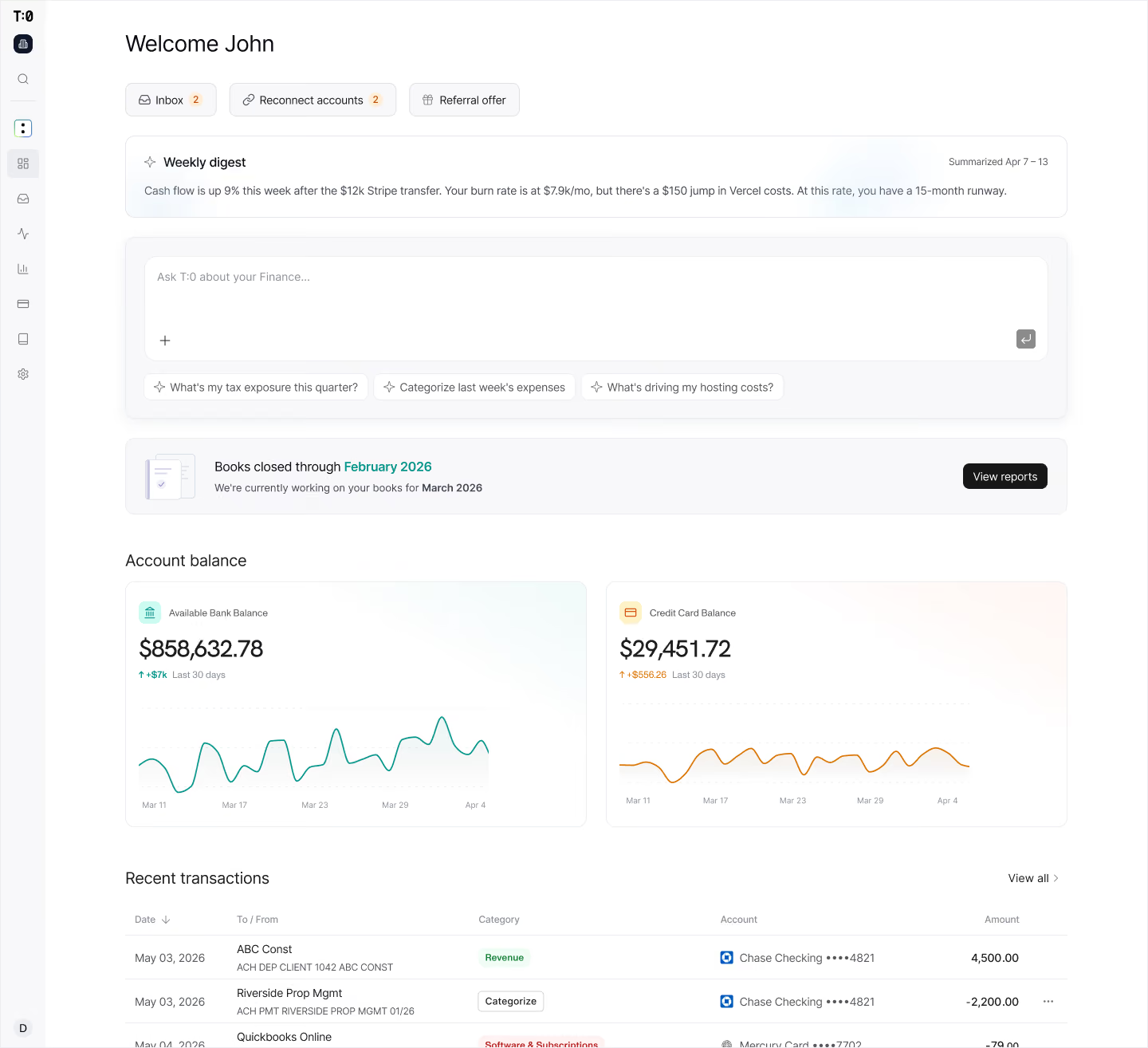
You connect all of that, and T:0's primary job right now is to ingest that data and transform it into objects that are normalized and clean. This is a T:0 invoice, a T:0 bill, linked back to the sources. From those objects, we build your books. We create journal entries. If you ask me what the one innovation we focus on is, it's taking real-life financial objects or events and turning them into journal entries, whether scheduled in the future or now, with the flexibility to adapt to your business. That's the key thing.
To your second question, the questions we need to ask the user are the same questions your accountant would ask. Anytime there's confusion. We built the system so it doesn't hallucinate or make things up. If you just wired $20k out of your bank account and you haven't connected us to the source, we have no way to tell what it is. So we're not going to guess. There will be an inbox item saying We don't know what this is; let us know. You don't even have to select from a nav bar. You can describe it in plain English, and we'll figure it out.
Then there's everything about your business profile, like where it's incorporated, because that matters when we file your taxes later. And if you have particular accounting practices. That doesn't matter for SMBs. They say, " Just pick the best for me, and we'll make you GAAP compliant, period. But when we sell to the mid-market, they already have existing practices, and continuity is very important. The system has to be flexible enough to configure its rules to match theirs. Sorry, all of this is a long answer. It's because I keep having to give SMB and mid-market.
Where Is T:0 Fully Automated & Where Is A Human In The Loop?
Today, and we'll possibly keep this practice for a while because it's very sensitive to get wrong; every set of books we close goes through a human CPA. That's a blanket rule. Whether you're a small company or a big company, we would never tell you your August books are closed, here's your up-to-date balance sheet and P&L, unless that was human-stamped.
That's the main loop. We have folks checking every stage of the pipeline, but the main outcome you want is the one that's checked.
What Does Your Eval & QA Process Look Like For Financial Statements?
For financial records, the cash flow statement, P&L, and balance sheet are the three core statements for every business, and those are heavily human-in-the-loop at different stages. We measure the time, and the trend must always be going down.
It's almost unfair to talk about an eval benchmark, because our system is built to learn. A simple example we encountered early: whenever we saw Uber, we said it's transportation. That's a good guess. However, Uber also has a monthly membership, Uber One. That's not a ride, and that's not travel and entertainment. That's a subscription. A very naive classifier would get that wrong in the beginning. The way our system works, if it's been corrected enough times—and that threshold varies—it gets added into the system on retrieval and doesn't make that mistake again.
So it would be unfair to publish an automation rate, because it just keeps getting better. If the business hasn't really changed, it's basically 100% from last month. That would be inflating, so I think it's unfair to publish.
How Does The T:0 Team Use AI To Build T:0?
We are as AI-pilled as you can get within the bounds of being compliant. We're SOC 2 compliant, and we're almost there on SOX. A lot of those rules put bounds on your deployment process and the number of approvers required to get a PR in, and we follow all of that.
Beyond that, we follow the same principle as most AI-native companies. Writing code is not a thing anymore. You talk to Claude. We have guardrails, verifiers, and checkers. The CI/CD pipeline takes a long time to run, and as soon as we optimize it, more people add more guardrails.
Importantly, if you put out a PR with Claude, you own that PR. That principle should hold for a very long time. Our job is to architect the system right. What the AI doesn't know is where you want to take the business, whether it should over-engineer or under-engineer, and whether the contracts between the big services are correct. But the minutiae of every method—it's Stone Age to write that down. This is where senior engineers become really high leverage. If you're a senior engineer, you know which parts of the system deserve attention and which parts you just have to move fast on. Same answer as most vertical AI companies.
What Is The Bigger Change T:0 Is Actually Driving?
I'm an engineer by training. I've published papers; I've done AI and statistics since back when it was called machine learning. So I always forget to sell the most important part, which is that everything we've talked about so far is just bookkeeping. And tax. But bookkeeping is a chore for founders. I've done this in every business I've run. You're never doing bookkeeping in the morning. It's an end-of-day thing you don't want to do, and it gets delayed for days, for months. We want to turn that into: we've taken care of that for you.
The beauty is that by doing it for you, we've cleaned your data. The only way to understand every entry and produce the ledger entries for each is to understand the data and clean it. Once it's clean, I can't even take credit for what happens next. Anthropic has post-trained models to be great at SQL. Agents are great at querying, great at writing code to visualize data. It's almost out of the box. Agents just run wild.
I'm more and more impressed. Just yesterday, someone on our product success team was helping run a cohort analysis for a client. They wanted to understand how much ad spend they paid for each cohort. Is LinkedIn working for me? Is cold email working? Is Google search working? Standard thing, we've all done it, but it's also very complex because the data is in many places. Once the data is clean, you just talk to the AI. Run a cohort analysis weekly, grouped by Google spend, LinkedIn spend, and Reddit spend. It does a first iteration, and here's the chart.
Then the founder wanted to modify it. The way their billing works, the ad spend is shifted by one or two weeks depending on the source. You spend on the ads today and settle the bill later. Previously, you'd have to do that by hand, shifting every platform by n weeks to join the data. But LLMs are super good at it. You say, for Google, shift by two weeks; for LinkedIn, shift by two weeks, and it's one go. You merge the right cohorts and know exactly what you spent on every ad. You can't dream of these cases until you see them in the wild. When the data is clean, it's party time, because Anthropic and OpenAI spent billions training these models.
What Learnings From Alphabet & Your Last Startup Are You Applying At T:0?
We certainly pay attention to guardrails, and that goes with the amazing team we have. I like to say I've done the Silicon Valley buffet platter. I maximized for diversity of experience. I've led groups in big labs doing drug discovery, some robotics work, and high-speed computer vision. I've done fintech and payments, which was my last company, acquired by Airwallex. I've been the first engineer at a startup that scaled into a unicorn. I've been pre-IPO through to IPO. I've just done the tour of duty, and I'm very fortunate to have met a lot of talented engineers, many of whom are working with us now. We have AI engineers and researchers from Google, Amazon, and Meta.
When you apply very smart people to a domain where you can verify the results, it's pretty clear what the answer is. There's one way to do bookkeeping. If you're not clear, go ask the accountants. We've hired CPAs because none of us are CPAs. We're engineers and nerds. We have CPAs in the office and CPA consultants, and whenever you're not clear, you go ask. If you put that combo in a room, the product will get built.
Well, one way is to be consistent. GAAP compliance is very funny. The main treatment is that you have to be consistent, and if you change your accounting practice, it has to be very clear why. We have audit logs for that.
How Will A Finance Team Look In Five Years?
This is a hard question, because every week there's a new model release. But I think it's still worth thinking about. We think finance teams will become strategists rather than manual laborers. I'll say that in a very blunt way.
You stop thinking about every small thing. Do we have the right receipts filed for this? Did the bank transfer land? When I sent it from one bank, did it show up in the other? All of that busy work goes away. The models should very soon be able to do all of it and then flag the mistakes, so you're only looking at the mistakes and the questions. You sent the wire from one of your businesses to the other, and we haven't gotten it on the other end.
What you're left with is the human touch and the human taste. The AI isn't in the room with the people running the business. It doesn't know where the business is growing or where you should invest. So everyone becomes a strategist. How do you use finance as a tool instead of a chore? Cash flows are going up, and I know this earlier than I used to. I don't have to wait until the end of the quarter. Maybe we can be more aggressive with hiring. Should we hire in this geo, or start hiring AEs in a separate geo? It becomes a strategy game. If you talk to any finance person I know, they all want to do this. That's the dream. We're bought into this future.
Additional Reads
T:0 Has Arrived: Real-Time Accounting and Financial Intelligence for Startups: Lance's September 1, 2026 launch essay, including the story of how Airwallex's acquisition of OpenPay was delayed because his books weren't in order, and the design principle behind T:0 (AI writes the accounting rules, a deterministic system applies them to the ledger).
Airwallex Expands From Cross-Border Payments to Autonomous Finance: Nicholas Gordon on the $320M Series H, the $11B valuation, and why an IPO is "not the best time," with Airwallex president Lucy Liu describing T:0 as assisted driving for your finance department.
Scaling a Finance Team From Startup to Scale-Up: a 20-minute conversation between Jack Zhang and Lance, published on September 2, 2026, on building an AI-native finance function end-to-end.
Outperform the competition.
Tools & resources, ranging from playbooks to databases, courses, and more.
Deep dives on famous visionary leaders.
Interviews with entrepreneurs and playbook breakdowns.
*This is sponsored content
Quick Poll
Lance says every set of books T:0 closes still gets stamped by a human CPA, and he plans to keep it that way for a while. How long until you'd trust AI to close your books with no human sign-off? |
|
Rate This Edition
What did you think of today's email? |
|












.svg)
.svg)