Here’s what’s on our plate today:
🧪 Inside the Pentagon's push to add AI to the polygraph.
📰 Can a non-binding pact fix AI's image? Altman on risk; communities defy AI data centers.
💬 Prompt of the Day: how to tell if a "deception-detecting" AI is accurate or just consistent.
🗳️ Poll: what's the real risk of an AI polygraph?
Let’s dive in. No floaties needed…
We build the tasks your model fails.
PhD researchers and domain experts author verified, containerized tasks in the Terminal-Bench and GDPval mold, spanning coding, finance, accounting, engineering, and more.
On our harder tasks, frontier models score 0 out of 5.
*This is sponsored content
Goodies delivered straight into your inbox.
*This is sponsored content
The Laboratory
TL;DR
The Pentagon is shopping for Pinocchio’s nose, and AI can’t grow one.
The push: the Pentagon wants AI and remote sensors in the polygraph, weeks after strapping its own Joint Staff to one over leaks.
The flaw: a racing pulse has many causes, so AI trained on old verdicts makes the machine more consistent without making it more accurate.
The trust: in a lab study, people who chose an algorithm that was wrong one time in three became about three times as quick to call someone a liar.
The target: aimed at one known leak, the test earns some authority, but across a whole workforce it flags mostly innocent people and could give the next Snowden pause.
The stakes: courts keep polygraph evidence out yet rarely see clearance cases, so whether this knife fillets or wounds depends on test results the Pentagon hasn’t promised to publish.
Inside Pentagon’s push to add AI to the Polygraph
In Disney’s 1940 film Pinocchio, the Blue Fairy asks the wooden puppet why he has not been to school, and he answers with an invented story. His nose grows longer with every new detail until it branches like a tree, and the lie becomes plain to anyone in the room. The nose needs no expert to read it, because in Pinocchio’s world a lie leaves a mark on the body that cannot be mistaken for anything else.
People have always wanted a nose like that, in a world where they spend their days talking and listening without knowing how much of it is true. A device that could say with accuracy when someone is lying would give every questioner the Blue Fairy’s advantage.
The Pentagon, which runs the U.S. military, is now asking for $30.3M over five years to move closer to one by adding AI to the polygraph, the lie detector its security officers already use. AI can make the polygraph more consistent, though it cannot make it more accurate. Because the test has always worked by being believed, a more scientific-looking machine would gain authority its evidence has not earned.
The project, called Polygraph Next, surfaced last month in MIT Technology Review, and its budget request would fund prototype tests of sensors that read the body at a distance and scoring software, starting with $6.42M in FY2027. Congress has not approved the money. The report came weeks after investigators polygraphed members of the Joint Staff over press leaks during the Iran war, partly, officials said, to deter future leakers inside the government.
AI can make the test consistent but not accurate
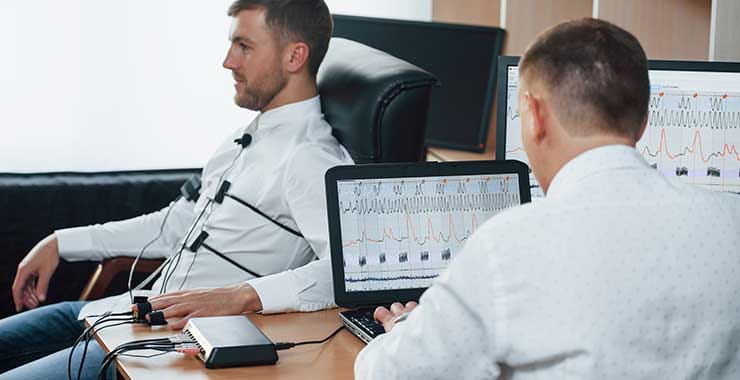
A polygraph measures stress, recording blood pressure, pulse, breathing, and sweat while an examiner compares reactions to neutral questions with reactions to relevant ones. The National Research Council, a scientific body chartered by Congress, found only a limited link between those readings and lying, since a racing pulse, unlike Pinocchio’s nose, has many causes.
Polygraph Next’s prototypes would read the same stress without straps and score it with software that learns from old files in which nobody confirmed who lied, a law professor told MIT Technology Review. Software trained that way copies past verdicts, like a student grading from a teacher’s old marks who picks up the teacher’s habits without learning which answers were right. No program can supply the confirmed answers the old files never had, so the machine can grow more consistent, and more trusted, without growing more accurate.
People follow a machine’s verdict whether or not it is right
A laboratory study in 2024 caught that trust at work, since people who chose to consult a lie-detecting algorithm almost always did what it said. The algorithm got roughly one call in three wrong, yet its users became about three times as quick to accuse others of lying.
Sophie van der Zee, who studies deception, argues that the polygraph’s real power lies in deterrence and confession, which work only while people believe in the machine. Treated as if it were Pinocchio’s nose, the test draws out admissions from people who believe their bodies will give them away. An automated score would likely deepen that belief on both sides, making examiners readier to trust verdicts and employees readier to fear them.
The test fits a narrow leak hunt far better than a workforce
The machine’s authority is firmest when aimed at a small group of suspects over one known leak, as in the Joint Staff inquiry, where the council found such tests perform well above chance. Turned on a whole workforce in a ‘screening’ test, with nobody suspected, it runs into a problem of numbers, because the people it is meant to catch are rare among those it tests. Every honest employee tested is another chance for a false alarm, so the innocent people flagged soon far outnumber the guilty ones caught. The council showed this holds even for a test better than any yet proven.
Screening also reaches people before anything has happened, including anyone deciding whether to report what they have seen. Intelligence community rules protect reports made through official channels but have never covered disclosures to the press. Edward Snowden took that route when he leaked documents revealing the National Security Agency’s surveillance of American citizens. A test people believe can detect deception could therefore weigh on whether someone in his position discloses anything. Someone troubled by what they have seen can also show the same stress as a committed leaker.
No court checks whether that authority is earned
The case for automation rests on fixing the examiner
The strongest case for Polygraph Next comes from the Defense Counterintelligence and Security Agency, which runs the program and presents automation as a remedy for examiner bias. The council documented that bias when it found that accuracy shifts with the examiner’s expectations. The agency’s case holds for a single leak hunt, where removing one examiner’s hunch helps, and the numbers favor the test. It weakens wherever the tool is used for screening, because consistent scoring of an unproven signal still flags mostly innocent people, now with a machine’s authority.
Pinocchio’s nose belongs to a fairy tale, and no sign of lying has been found that holds for every human body, van der Zee told MIT Technology Review. To have flaws is to be human, and lying is a flaw people will always carry, because nobody can express every thought they want to share in perfectly truthful terms. Everyone holds something back, and a machine that reads that gap as stress treats a human habit as a warning sign. If people ever achieved complete truthfulness, the social and political structures they have built would likely begin to crumble.
The Pentagon’s push may sound like a good idea, but it could become the sharpest of knives. Used on a single known leak, it can fillet a fish with care, while used indiscriminately across a workforce, it cuts into loyal employees and anyone deciding whether to speak up. The public cannot yet judge which way it will cut, since the Pentagon has not said whether its test results will be published. Until they are, the machine’s power will rest on what people believe about it.
Bite-Sized Brains
Can a non-binding pact fix AI's image: TechCrunch examines whether grand "super intelligence" rhetoric and a voluntary safety accord can repair AI's growing trust problem, or just paper over it.
Altman: benefits warrant some risk: Sam Altman argued AI's upsides justify accepting certain risks, a framing critics say conveniently leaves the companies to decide which risks are worth taking.
Communities defy AI data centers: Local communities are increasingly organizing to block Amazon's AI data centers, as the fight over power, water, and land moves from policy debates to town halls.
The context to prepare for tomorrow, today.
*This is sponsored content
Prompt Of The Day
| Act as a skeptical science reviewer. I'll describe an AI system claimed to detect deception. Walk me through how to tell whether it's actually more accurate or just more consistent, what training data it would need to prove the claim, and what questions to ask about its false-positive rate. |
Tuesday Poll
🗳️ The Pentagon wants to add AI to the polygraph, making it more consistent but not more accurate. What's the real risk? |
|
The Toolkit
Deepgram: Speech-to-text API built for scale, handling real-time transcription and voice intelligence for production apps.
Descript: AI-powered audio and video editor that lets you edit recordings by editing the transcript like a doc.
Drift.ai: AI add-in for Excel that makes financial models context-aware and queryable, built for investment banking, VC, and corporate finance teams.
Rate This Edition
What did you think of today's email? |
|









.svg)
.svg)