Here's what's on our plate today:
🧪 Why a video call no longer proves who is calling.
📰 Anthropic's founders take control via an LLC; Trump hosts AI CEOs; The Information tracks 77 trends.
🛠️ Three things worth trying: Content Credentials, Deepware Scanner, FBI IC3.
Let’s dive in. No floaties needed.
Put your brand in front of 250,000 tech decision-makers.
Bay Area Times reaches more than 250,000 founders, operators, investors, and venture capitalists, 90% of them in the United States, with a 53% open rate.
Native placements sit inside the editorial flow rather than beside it, so your message gets read with the news instead of scrolled past. Slack, Attio, and Granola have run here.
Placements range from a single secondary slot to a full newsletter takeover.
*This is sponsored content
Goodies delivered straight into your inbox.
*This is sponsored content
The Laboratory
TL;DR
AI has taken over the parts of investment fraud that careful people used to catch.
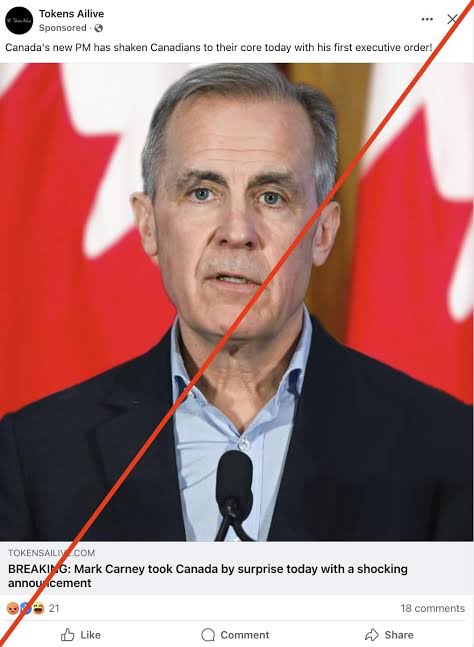
The hook: an 86-year-old Ontario widow saw a deepfake of Mark Carney promoting a $350 investment and lost nearly C$1M to the callers who followed.
The broken checks: deepfakes built from real footage, AI-written messages, forged documents, and face-swapped video calls now pass the tests that once exposed scammers.
The human core: months of phone calls, borrowed from pig butchering, still do the work of taking the money.
The murky numbers: impersonation scams grew more than 1,400%, but AI-linked complaints account for about 4% of FBI-reported losses, and many victims never learn what fooled them.
The stakes: in a lab test, an AI partner persuaded 46% of people, compared with 18% for humans, which suggests the last human stage of the scam could be next.
Why asking for a video call no longer protects you from scammers
Catfish, the MTV series that has been on the air since 2012, follows people who have fallen for someone they have only ever met online, sometimes after months of daily messages. However, since anyone can type anything and borrow any photo, the people who write in to the show usually share one nagging doubt: the person they love always has an excuse for never turning on the camera. The hosts settle that doubt by tracking the person down, and the truth arrives the moment a live camera shows who has really been typing. A video call became the standard advice for anyone falling for someone online, because a scammer hiding behind stolen photos has no real face to show.
Investment fraud runs on the same borrowed trust, with a stranger online persuading someone to move their savings into a scheme that looks like a real opportunity. However, since few people will hand money to a stranger, scammers have long used the face of someone the victim already trusts, such as a famous investor or a senior politician, in an ad promoting the scheme. Careful people learned to check those ads, since a fake endorsement used to mean a stolen photo and an invented quote, and it fell apart once someone looked for the real video or asked to see who they were talking to.
Generative AI is now making checks difficult because it can produce a convincing video of a real public figure recommending an investment and superimpose a borrowed face over a scammer’s own during a live call. The tools have taken over the parts of the scam that a careful person used to catch, meaning the endorsement, the written messages, and the face on the screen. People still make the months of phone calls that actually take the money. As a result, the fraud now reaches people who would have spotted it a few years ago.
A fake prime minister opened the door to one widow’s savings
Judy Skene, an 86-year-old widow in Ontario, saw a Facebook ad last year that appeared to show Mark Carney, now Canada’s prime minister, recommending a $350 investment backed by the Bank of Canada. Carney ran that bank before he entered politics, so a video of him vouching for it carried the kind of authority a sensible investor looks for. CBC later found that one such ad had been built from real footage of the January 2025 speech launching his campaign to lead his party, reworked so that he appeared to promise profits from a small deposit.
Skene made the $350 deposit, and the fraud then followed the pattern that the Canadian Anti-Fraud Center, the national body that collects fraud reports, described to the National Post. A caller posing as an investment adviser follows up, and the victim is shown a professional-looking trading website where the first deposit appears to grow. Those profits are fabricated, but they persuade the victim to invest more, usually by buying cryptocurrency. Eventually the callers ask the victim to install remote access software, which lets them control the computer directly.
Over the following months, Skene withdrew money from a retirement account, took out a mortgage on her condo, and made a $35k credit card cash advance. Her losses reached nearly $1M in Canadian dollars, according to National Post reporting relayed by CyberNews in July.
The deepfake did one job: to make a stranger’s offer look like it came from someone Skene had reason to trust, and people on the phone did everything after that. CBC’s fact-checkers have since found Carney deepfakes on YouTube in April, Truth Social in May, and Facebook again in August, after dozens of readers wrote in about them. The months of calls that followed come from an older kind of fraud that runs on human labor.
The calls follow the method of pig butchering
That older fraud is ‘pig butchering,’ a translation of the Chinese ‘sha zhu pan.’ The U.S. Treasury describes it as building a relationship with a victim over weeks or months, steering them to invest on a platform the scammers control, and then disappearing. The relationship is the fattening before the slaughter. Much of it is carried out in guarded compounds in Cambodia, Myanmar, and neighboring countries, where trafficked workers are forced to hold the conversations. Chainalysis, a firm that traces cryptocurrency payments, found that pig-butchering payments drop noticeably during the Chinese New Year holiday, suggesting that operators in East and Southeast Asia run much of the trade.
Skene’s case borrows that method without matching it exactly, since a fake prime minister did the job a fake romance usually does. No public source ties the Carney ads to any particular network. AI now serves both kinds of scam, and it has changed the first contact far more than the calls that follow.
AI has defeated each check a careful victim could once run
The first check was the endorsement itself, and a video built from a politician’s real speech survives a search for real footage because it is real footage, reworked. The second check was the writing, since scam workers are usually writing to people in countries and languages other than their own. OpenAI’s July 31 disruption report describes a network around Poipet, a Cambodian border town, that used ChatGPT to run fake personas and to write and translate messages to targets. The same network used it to forge passports and stock-purchase confirmations, so a suspicious victim who asks for proof of identity or proof of a trade can be handed a convincing document.
The third check was the video call, the same test that exposes the impostors on Catfish, and it was historically where romance scams collapsed. Hong Kong police arrested 27 people in October 2024 in a ring that swapped the scammers' faces for those of women during live calls and took about $46M. Wired found that Haotian, a Chinese-language face-swap service, was marketing to pig-butchering operators and claimed its fakes survived the common trick of asking the caller to wave a hand across their face.
None of these tools invented a new scam, and OpenAI reported last October that most of the scam activity it disrupted involved fitting AI into existing playbooks. Each tool removes a moment where a careful person used to catch the old scam, which widens the pool of people the same playbook can work on. That wider pool should show up in the losses, though the figures capture it only in part.
The losses are rising faster than AI’s share can be measured
Impersonation scams borrow a trusted person’s identity, which is the job a deepfake is designed to do. Chainalysis estimates that $17B was lost to crypto scams in 2025 and found that impersonation scams grew by more than 1,400%. Operations that bought AI tools, with payments visible on the public ledger, took $3.2M each, compared with $719k for those that did not. That gap of 4.5 times is an association because larger operations are also the most likely to buy tools, so the tools may reflect size rather than cause it.
The FBI’s Internet Crime Complaint Center, which collects reports from American victims, records a much smaller AI footprint. Its 2025 annual report counts 22,364 complaints mentioning AI, carrying $893.3M in losses against $20.877B in total, or about 4% of the money. The same report records that 78% of crypto investment victims the FBI contacted had not realized they were being scammed, and a victim who does not know they were scammed cannot know whether AI was involved either.
Canada’s numbers have the same blind spot, since the Anti-Fraud Center recorded $351M lost to investment fraud out of more than $704M reported in 2025, while the Competition Bureau estimates that only 5% to 10% of fraud is ever reported. The commissioner of the Royal Canadian Mounted Police, the national police force, appears in this year’s Fraud Prevention Month video holding up a deepfake of himself. None of these figures can say how much of the loss AI causes, but they show impersonation scams, the kind a convincing fake face is built for, growing sharply, along with victims who often never learn what fooled them.
Ads and payments shape how far the fakes reach
Some of the people tracking these losses focus on the ads and the money, because those decide how far any of this spreads. A deepfake only reaches an 86-year-old because someone paid to put it in front of her. Reuters reported that Meta projected about 10% of its 2024 revenue, roughly $16B, would come from ads linked to scams and banned goods, a figure Meta disputes. The United Nations Office on Drugs and Crime focuses on the money end, and its regional representative Delphine Schantz argues that seizing criminal proceeds hurts these networks most.
Both points fit what the Carney cases show, and they sit alongside the account of the tools without replacing it. Removing a single AI vendor changes little when UN officials count more than 10 face-swap tools in the region, which gives ad systems and payment routes real weight as places to intervene. The Carney fakes have also moved across three platforms, though, so the ad systems are as replaceable as the tools, and a seizure arrives only after victims have paid. The calls, the stage people still do by hand, sit beyond the reach of either.
The last human part of the scam may be next
On Catfish, the truth arrives when the camera shows who has really been typing, and a face-swapped call now lets a scammer pass that test. The conversation behind the face is the last part still done mostly by people, and a peer-reviewed study presented at USENIX Security 2026, a leading computer security conference, suggests it may not stay that way. Its authors interviewed 145 scam insiders and found that 87% of scam work is scripted conversation that could be automated. In a week-long blinded test, a partner run by an AI model earned more trust than human operators and persuaded 46% of participants to comply with a request, against 18% for the humans.
The test used a harmless app install in place of a payment, and nothing yet shows such a system running at scale. A fabricated face got Skene’s first $350, and human voices on the phone got the rest, which leaves open the question of what a careful person can still check when the face, the documents, and the conversation can all come from a machine.
Thursday Poll
📊 Deepfakes now beat the endorsement check, the document check, and the live video call. What still works? |
|
Your ads are only as good as your data.
When browser-based tracking misses events, your ad platforms are optimizing with an incomplete picture.
Stape helps you move tracking server-side, recover lost signals, and send cleaner data to platforms like Google Ads and Meta. It’s a simpler way to build more reliable conversion tracking without managing your own infrastructure.
Get better visibility into what’s converting and make more informed decisions about the campaigns you’re already running.
*This is sponsored content
3 Things Worth Trying
Content Credentials Verify: Free in-browser tool that reads a file's signed provenance trail, the check that works when a fake can't be spotted by eye.
Deepware Scanner: Free scanner that checks a video or link for face-swap manipulation, useful for the exact test Hong Kong's ring defeated.
FBI IC3: The complaint portal behind the $20.877B loss figure, and the only place a victim's report actually enters the count.
Quick Bits, No Fluff
Anthropic's founders lock in control: Its IPO filing creates a "Founder LLC" of seven co-founders directing a single Class F share that carries 50.1% of voting power.
AI CEOs lunch at the White House: Jensen Huang, Dario Amodei, and Alex Karp joined Trump and Speaker Mike Johnson to argue over AI risk and whether Congress should legislate.
The Information indexes AI trends: Its Inflection Index tracks 77 AI trends across roughly 9.5k articles and claims early catches on power demand and custom inference chips.
The Toolkit
Reality Defender: Multimodal deepfake detection across voice, video, images, and text, with real-time risk scoring via API.
Pindrop: Voice fraud detection built for call centers, flagging cloned and synthetic callers mid-conversation.
Truepic: Content provenance from the moment of capture, cryptographically signing media so its origin can be proven later.
Rate This Edition
What did you think of today's email? |
|











.svg)
.svg)