Here’s what’s on our plate today:
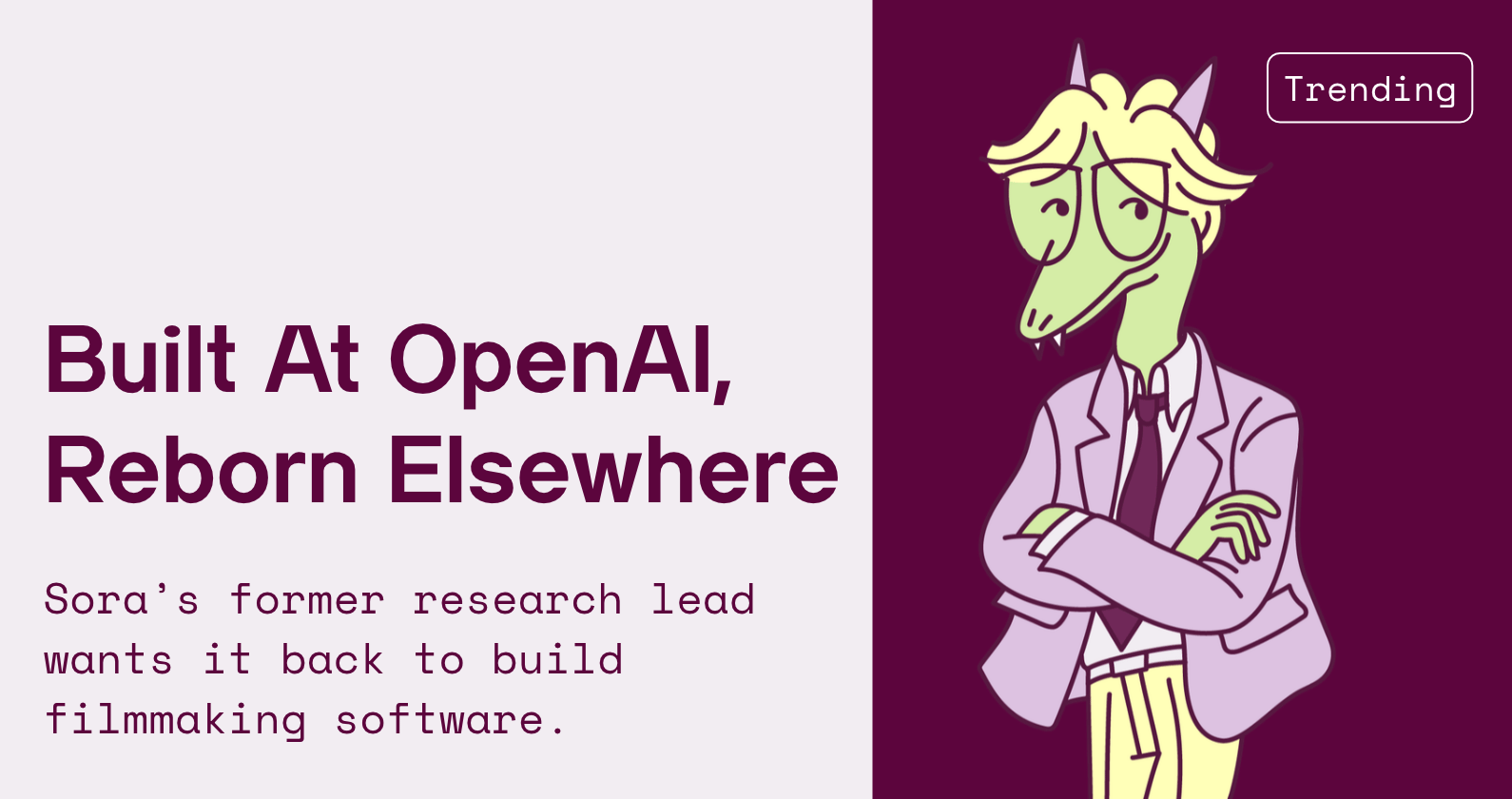
🧪 OpenAI may hand Sora to Bill Peebles’ new startup.
📰 ASML forecasts strong Q4; Zuckerberg doubted his AI bet; FBI arrests OpenAI engineer.
🧰 Three tools worth trying: Google Flow, LTX Studio, Moonvalley.
Let’s dive in. No floaties needed.
You might be missing more data than you think.
Browser restrictions, ad blockers, and tracking gaps can quietly leave your marketing data incomplete.
Not sure where your setup stands? Use Stape’s free Website Tracking Checker to uncover potential gaps, compare your tracking setup with competitors, and see where you could improve—all in just a few minutes.
*This is sponsored content
We build the tasks your model fails.
PhD researchers and domain experts author verified, containerized tasks in the Terminal-Bench and GDPval mold, spanning coding, finance, accounting, engineering, and more.
On our harder tasks, frontier models score 0 out of 5.
*This is sponsored content
The Laboratory
TL;DR
Google once gave Glass a second life on factory floors, and OpenAI may now give Sora one too, except that someone else would run it.
The toy that failed: the Sora app lost its audience within months, and a single day of running it reportedly cost more than its users spent in a month.
The handover: on October 12, 2026, The Information reported that OpenAI is discussing passing Sora to a startup co-founded by its former research lead, Bill Peebles, in exchange for part-ownership.
The frozen model: OpenAI stopped training new video models, so the startup would inherit a head start, with the finished product still to be built.
The crowded market: filmmakers already buy from Runway and Google, and appear to pay for the tools around a model as much as for the model itself.
The stakes: if the deal closes, AI labs gain a way to stop paying for costly models while keeping a share of what those models go on to earn.
Why OpenAI may hand Sora to the man who built it
In June 2012, Sergey Brin, Google’s co-founder, stopped his company’s developer conference in San Francisco and handed the stage to a team of skydivers circling the city in a zeppelin. They jumped wearing Google Glass, a pair of glasses with a small screen and a camera built into the frame, and the audience below watched the whole fall through the jumpers’ own eyes, live, as if they were the ones falling. For a moment it looked like the future of how people would see and share the world. Google then sold Glass to the public for $1.5k, and the people who bought the glasses found that the future felt different on an ordinary street. A camera on their faces made others uncomfortable with the idea of being recorded without their knowledge, and the device that had dropped out of the sky over San Francisco ended up as something people were wary of in the room. Google stopped selling Glass to consumers on January 19, 2015.
The device came back two years later, this time without the zeppelin, because the same camera that had unsettled strangers had a use where people were working. Google launched Glass Enterprise Edition in July 2017 as a module that clipped onto the safety glasses workers already wore, and sold it to farm machinery makers, hospitals, and DHL. The public had rejected Glass as a toy, but businesses were willing to pay for it as a tool. A product its maker had written off found a second life with a smaller and more serious audience, on factory floors rather than in the sky.
OpenAI’s Sora, an AI system that turns a written description into a video clip, is now on the same road, from public spectacle to professional work. The two stories part ways at one turn. Google kept running Glass itself when it moved the device onto factory floors, but OpenAI may hand Sora’s second life to someone else. On October 12, 2026, The Information reported talks between OpenAI and a startup that wants to build filmmaking software on Sora, co-founded by Bill Peebles, who led Sora’s research at OpenAI, and the Hollywood executive Jeffrey Katzenberg. The Information called it a plan to revive Sora, but the terms it reported describe a handover: OpenAI would give the startup a model it has already retired, and in return it would own part of the startup. If the deal closes, its implications would reach well beyond one video model, because it would show other AI labs how to stop paying for an expensive model while keeping a share of whatever it goes on to earn.
OpenAI closed Sora because the public version cost more than it earned
Sora’s first life looked a lot like Glass’s: a new technology handed to the public as a toy and judged by whether people wanted to keep playing with it. OpenAI released the Sora app in September 2025 around ‘cameos’, which let people record their face and voice once and then drop themselves and others into scenes that had never been filmed. For a while the idea worked, and the app climbed to the top of Apple’s App Store. The novelty wore off within months, though. App analytics firm Appfigures found that downloads fell 45% in January while monthly spending in the app dropped from $540k to $367k, according to TechCrunch.
The fading interest hurt OpenAI more than it would hurt an ordinary app, because every clip a user made had to be paid for in computing power. The Wall Street Journal reported that running Sora cost OpenAI about $1M a day, which means a single day of keeping the app running cost more than its users spent inside it during the whole of January. OpenAI was paying a large bill every day to entertain an audience that was already drifting toward the exits.
The clips also carried the problem that had followed Glass out of the store, because a tool that can put anyone’s face into a video can just as easily be turned on people who never agreed to appear in it. The Associated Press reported warnings about deepfakes, realistic fake videos of real people, spreading through the app. OpenAI restricted clips of figures such as Martin Luther King Jr. only after their estates and an actors’ union objected. Left with an app that cost more to run than it earned and was hard to police, OpenAI announced on March 24, 2026 that it would close it.
The startup would inherit a model OpenAI has stopped developing
The Information’s headline talks about reviving Sora, a word that makes it sound as if the model has only been paused and could be switched back on, but OpenAI took Sora apart piece by piece over six months. The app went first, closing on April 26, 2026, as OpenAI’s help center records. Then, on September 24, just 18 days before the report, OpenAI closed the API, the paid connection that let other businesses plug Sora into their own software. The Journal also reported that OpenAI had stopped training new video models, the long and expensive process that makes a model better over time, which would leave the Sora now on the table frozen exactly as it was in early 2026.
A startup would still want that frozen model because of what is stored inside it. Everything Sora learned about how video looks and moves is held in its ‘weights’, the billions of numbers it absorbed during training, much as years of practice live in a craftsman’s hands. Whoever holds those numbers can use the model to make videos or keep teaching it new skills. According to The Information, the startup wants enough access to keep teaching Sora so that it can shape the model around what filmmakers need. Whether OpenAI would hand over the weights themselves is still undecided, and so is the question of who would pay for the computer chips that produce every clip.
For OpenAI, the deal would turn a model it no longer wants to pay to run into part-ownership of the startup, known as an ‘equity stake’, which grows in value if the startup does well. OpenAI could do this without spending any more of the computing power it has redirected to coding and business products. For the startup, the gain would be time, because its founders had planned to build their own video models from scratch, The Information reported in September, and starting from Sora would save them months of work and a large bill for computing power.
Filmmakers buy the tools around a model as much as the model
Glass Enterprise Edition was designed to clip onto the safety glasses workers already wore, and filmmakers choose AI video tools in much the same way, by how easily the tools fit into the work they already do. The startup would be competing for those filmmakers against companies that already serve them. Runway, the largest independent company selling AI video tools to professionals, raised $315M from investors in February in a deal that valued it at $5.3B. Google sells Flow, a filmmaking tool that runs on its own video models, called Veo.
Runway’s paid plans now also offer Seedance 2.5, a video model built by ByteDance, the company that owns TikTok, alongside Runway’s own model. A leading platform willing to sell a rival’s model next to its own suggests that filmmakers pay for the editing tools built around a model as much as for the model underneath, much as a driver judges a car by how it drives more than by which engine sits under the hood. Sora would enter that market as one engine among several, and by the Journal’s account an older one.
The film studio Lionsgate learned the same lesson from the other direction. It tried to build a model trained only on its own library of films, but the effort stalled, according to the entertainment news site TheWrap, and by June 2026 the studio had switched to Runway’s general-purpose models. Customers in professional video therefore choose a company for the tools it builds around a model, and the startup would have to build those tools whether or not it gets Sora. The old model would give it a head start, but the finished product would still have to be built.
The revival reading rests on demand that has yet to show its revenue
The strongest case for calling the deal a revival, as The Information did, is that OpenAI would find a better home for an expensive model without spending any more of its own computing power. The money moving into professional video supports that view. Investors including NVIDIA and Fidelity backed Runway at its $5.3B valuation, and Lionsgate tied itself more closely to Runway, both signs that professionals are willing to pay in a way the people using the phone app never were.
That case is right that the demand is there, but it has not yet shown that the demand turns into money. None of the revenue figures for professional AI video comes from the companies themselves or from official filings, and the one studio experiment on record took a year to show results. Neither OpenAI nor the startup has confirmed the talks, and if OpenAI keeps the weights to itself, the deal could shrink to little more than permission to use a model it has already shelved. Katzenberg’s own record adds to the doubt, because Quibi, the mobile video service he co-founded, raised $1.75B and shut down after about six months. He told CNBC at the time that Quibi had asked people to pay before they understood what it was. Against that, The Information’s source said the startup would get enough access to change the model substantially, which is far more than simple permission to use it.
Glass’s second life lasted longer than its first. Google sold the enterprise version for almost six years, until March 15, 2023, long after the skydivers and the $1,5k price tag had faded from memory. Businesses kept buying it through that stretch, but Google was still the one paying to build and support it, and in 2023 it stopped selling it. If the Sora deal closes, the arrangement would run the other way, because OpenAI would own a share from a distance while the startup does the work of finding customers and keeping them. Along with the model, the startup would inherit a question: whether filmmakers will pay enough, for long enough, to cover the costs that the people making cameo clips on their phones never covered.
Quick Bits, No Fluff
ASML sees a bigger Q4: The chip toolmaker forecast fourth-quarter sales of €14.2B to €15.2B, above expectations, and expects its planned supply to fall short of demand in 2027 and 2028.
Zuckerberg’s $200B shrug: Meta’s CEO admitted he committed up to $200B to AI infrastructure before his chief AI officer could say it would work.
FBI arrests an OpenAI engineer: Federal agents charged the employee with hiding a recording device in an executive conference room to capture talks about OpenAI’s technology.
Reach founders and investors where they already pay attention.
A native placement in Bay Area Times puts you in a daily edition that 250,000 business and tech professionals actually open.
90% are in the US, and the reader list skews founder, operator, and investor.
Choose a secondary slot for a single clear message, a main placement with logo and visual, or take over an entire edition. Slack, Attio, and Granola have all run here.
*This is sponsored content
3 Things Worth Trying
Google Flow: Google’s filmmaking tool built on its Veo video models, a live test of whether filmmakers pay for the tools more than the engine.
LTX Studio: Storyboard-to-video platform that plans scenes, shots, and characters, the kind of workflow layer a Sora startup would still need to build.
Moonvalley: Video model trained on licensed footage and pitched to studios, a reminder that clean rights can matter as much as raw quality.
Thursday Poll
📲 OpenAI may hand Sora to a startup for part-ownership. What should labs do with models they retire? |
|
The Toolkit
Luma AI: AI video generator that turns text and images into realistic, camera-aware clips for creative teams.
Pika: Playful AI video app that turns prompts and photos into short, effect-heavy clips for social.
HeyGen: AI avatar video platform that clones your face and voice for presentations, training, and localized content.
Rate This Edition
What did you think of today's email? |
|






.svg)
.svg)