Here's what's on our plate today:
🔬 China now employs more top-published AI researchers than the U.S.
📰 AI dominates Climate Week; Florida seeks an OpenAI model ban; Google appeals the EU's Android order.
📋 Weekend To-Do: read the talent tracker, the AI Index, the DeepSeek study.
Let’s dive in. No floaties needed…
Put your brand in front of 250,000 tech decision-makers.
Bay Area Times reaches more than 250,000 founders, operators, investors, and venture capitalists, 90% of them in the United States, with a 53% open rate.
Native placements sit inside the editorial flow rather than beside it, so your message gets read with the news instead of scrolled past. Slack, Attio, and Granola have run here.
Placements range from a single secondary slot to a full newsletter takeover.
*This is sponsored content
Label Faster. Train Smarter. Ship Better Models.
Multimodal models are only as good as the data behind them. Our trainers work across text, audio, and image pipelines—handling transcription, labeling, and annotation tasks with speed and consistency.
Audio transcription and speech data labeling
Image and video annotation for vision model pipelines
Multilingual coverage across Portuguese, Spanish, and English
*This is sponsored content
The Laboratory
TL;DR
China now leads the U.S. as a workplace for top published AI researchers, a lead it built by training its own while America lost the next generation.
The crossover: a Carnegie China study puts 40.6% of top AI researchers in China in 2025 and 34.2% in the U.S., reversing a 2022 split of 27.1% to 46.4%.
The academy: Chinese-educated researchers rose from 29% to 47% of NeurIPS authors between 2019 and 2022, and fewer of them now move abroad.
The lost cohort: 87 of 100 Chinese-trained researchers in the U.S. stayed, but arrivals of AI researchers to the U.S. have fallen by 89% since 2017.
The caveat: the ranking counts only researchers who publish, and U.S. labs such as OpenAI publish little of their work.
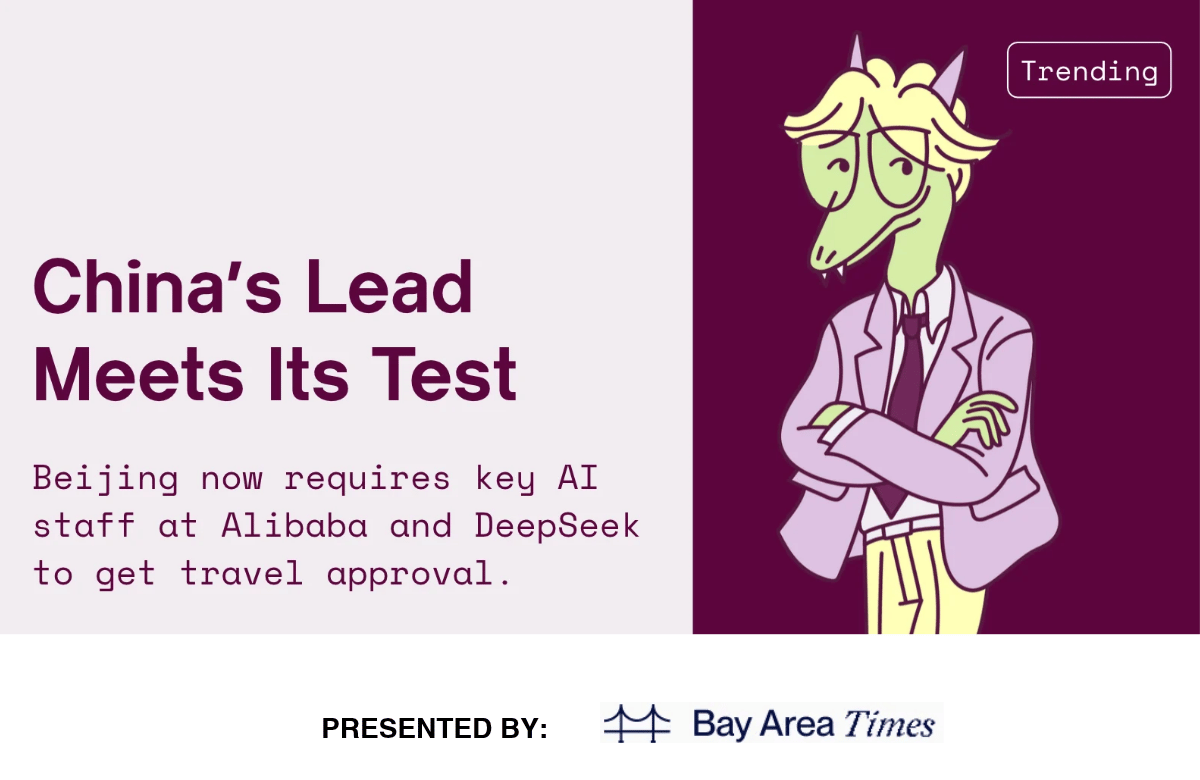
The stakes: Beijing now requires AI staff deemed strategically important at firms such as Alibaba and DeepSeek to get approval before traveling abroad, testing whether a lead built on choice survives once leaving needs permission.
How China beat the U.S. to become the top workplace for published AI researchers
In 2010, the three finalists for the Ballon d’Or, football’s yearly award for the world’s best player, were Lionel Messi, Xavi Hernández, and Andrés Iniesta. All three had come through La Masia, the youth academy of FC Barcelona, which took them in as boys and raised them in the club’s way of playing. Real Madrid, Barcelona’s great rival, spent those years paying record fees for stars that other clubs had developed. Barcelona never had to outbid anyone for the three players on that podium, because a club that grows its own talent and keeps it stops depending on transfer fights.
China is now the club with the academy, since more of the world’s top published AI researchers work there than in the U.S. It built that lead by training its own researchers and keeping more of them at home, which has changed how the market for AI researchers works. Chinese employers now compete for the graduates American labs once took almost by default, while the U.S. has held on to the researchers it already had and lost the ones coming up behind them.
That finding comes from a study by Carnegie China, the China center of the Carnegie Endowment for International Peace, which The Information summarized on September 23, 2026. It found that 40.6% of top AI researchers worked in China in 2025 against 34.2% in the U.S., three years after a split of 27.1% in China and 46.4% in the U.S. In three years, the U.S. went from employing nearly half of these researchers to about a third, while China went from about a quarter to about two in five.
China climbed by training more researchers and keeping them at home
China’s climb makes sense once it is clear who the study counts, since it treats anyone who co-wrote a paper accepted at NeurIPS, the Conference on Neural Information Processing Systems, as a top-tier AI researcher. NeurIPS is one of the most selective research meetings in AI, and MacroPolo, the Paulson Institute’s think tank, which has tracked its authors since 2019, treats them as roughly the best 20% of the field. A name on an accepted paper works much like a place in a first-team lineup, and each author is counted in the country of the employer listed on it. A country can climb that count by producing more of the players or by keeping more of the ones it produces, and China did both.
China’s first advantage was production, because a growing part of the lineup now comes out of its own universities. MacroPolo’s tracker found that researchers with Chinese undergraduate degrees rose from 29% of NeurIPS authors in 2019 to 47% in 2022. About three in 10 of these authors had studied in China at the start of that period, and close to one in two had by the end. A country that trains that much of the pool needs only a modest share of its graduates to stay home before it tops a count of where the pool works.
China’s second advantage was keeping those graduates, since researchers everywhere have become less likely to leave home for work. MacroPolo found that 42% of top-tier researchers worked outside their home country in 2022, 13 points fewer than in 2019. Researchers who once expected to build a career abroad are increasingly building it where they studied. The Hoover Institution and Stanford HAI found the pattern inside DeepSeek, the Chinese AI lab, where more than half of the 271 authors with known employers, 53.5%, had never worked outside Chinese institutions.
Those graduates had reasons to stay on both sides of the Pacific, and the first came from American policy. Carnegie’s Matt Sheehan and Sophie Zhuang trace frictions piling up after 2018, from visa limits and renewal delays to device searches at customs. Each of those frictions made the old route of a Chinese degree followed by an American doctorate harder to take.
The second reason came from China itself, since its companies and universities now build frontier models, the most capable AI systems of their moment. A decade ago, frontier work was scarce in China, and today researchers can do it at home without moving abroad or working in a second language.
More graduates, more of them staying, a push from Washington, and a pull from home together explain the crossover. None of those forces required American labs to lose the researchers they already employed, so the American side of the story is about the researchers who stopped arriving.
America kept its researchers and lost the next generation
The researchers who stopped arriving account for most of America’s loss, because the U.S. held on to nearly everyone it already had. Sheehan and Zhuang followed 100 researchers who first trained in China and were working at U.S. institutions in 2019, and by 2025, 87 of them were still there. Nearly nine in 10 stayed put, which is why the authors conclude that the U.S. keeps the talent it has and is losing its ability to attract the next generation.
Stanford’s 2026 AI Index, the university’s yearly survey of the field, shows how steep that second loss has become. AI researchers and developers moving to the U.S. have fallen 89% since 2017, so for every nine who arrived that year, roughly one arrives now.
A loss of arrivals takes effect slowly, much as a company that keeps its senior staff but stops winning graduate hires can look healthy for years. The damage shows up later, when it needs new team leads and finds that the people who would have filled those jobs were trained and promoted by a competitor. American AI is early in that story, since its established researchers remain while the cohort that would have replaced them builds careers at Chinese labs. That reading depends on the ranking measuring what it appears to, and the people who know these counts best are careful about how far it does.
The ranking’s limits shrink China’s lead without reversing it
The caution about the ranking comes from the other counts of the same field, and it starts with what a count of published researchers leaves out. China’s lead covers one measure of elite research, the researchers who get papers into NeurIPS, and says little about how many AI researchers each country employs in total. On that wider measure, Stanford still finds the U.S. home to the most AI researchers and developers by far.
The count can also move without anyone changing jobs, because NeurIPS keeps growing. It accepted nearly twice as many papers in 2022 as in 2019, 2,671 against 1,428, and the conference has kept expanding since. When the lineup almost doubles, the U.S. can put more researchers on it than before and still end up with a smaller share, since China is adding researchers faster.
American labs shrink their own share further by publishing less, which keeps many of their researchers off the lineup altogether. Science reported that OpenAI, with roughly 4,500 staff, had only eight researchers with five or more qualifying papers, so one of the biggest employers of AI researchers barely registers in a count built on papers.
The method raises a last doubt, because the full report is unpublished and Carnegie’s own December article put the U.S. share in 2022 at 42%, more than four points below the new study. Some of the American drop may therefore come from how researchers were counted.
Those limits suggest China’s lead is smaller than the headline figures make it look, though they do little to change its direction. Every other measure, from MacroPolo’s trend to Stanford’s fall in arrivals, shows more researchers staying in China and fewer moving to the U.S. Whether that direction holds now depends on something no count can measure, which is whether researchers keep choosing to stay.
Beijing is now testing whether its researchers will stay by choice
An academy holds its advantage only while its players choose to stay, and China’s lead was built by researchers who chose to stay or return. Beijing has now started to limit that choice, and Fortune, summarizing Bloomberg, reported in May that AI staff at private firms such as Alibaba and DeepSeek need approval to travel abroad. The next NeurIPS list and the full Carnegie China report will show whether the crossover holds on a consistent count, but neither can yet show whether China’s academy keeps its pull once leaving requires permission.
Weekend To-Do
Your ads are only as good as your data.
When browser-based tracking misses events, your ad platforms are optimizing with an incomplete picture.
Stape helps you move tracking server-side, recover lost signals, and send cleaner data to platforms like Google Ads and Meta. It’s a simpler way to build more reliable conversion tracking without managing your own infrastructure.
Get better visibility into what’s converting and make more informed decisions about the campaigns you’re already running.
*This is sponsored content
Friday Poll
🇨🇳 China now employs more top published AI researchers than the U.S. What flipped the count? |
|
Headlines You Actually Need
AI took over Climate Week: Climate leaders gathering in New York spent the week split over whether AI speeds up the fix or the gas buildout, with the UN's climate chief saying tech leaders are on thin ice over public support.
Florida wants OpenAI's models paused: Florida's attorney general asked a judge to bar OpenAI from building new models without outside oversight, keep minors off ChatGPT, and stop the company from giving its chatbot human attributes.
Google appeals the EU's Android order: Google is challenging two DMA decisions that would open Android to rival AI assistants and share search data with competing engines, arguing both would harm user privacy and security.
Meme Of The Day
The Toolkit
Elicit: AI research assistant that searches millions of papers, summarizes findings, and extracts data into comparison tables.
Consensus: Search engine that pulls evidence-backed answers straight from peer-reviewed papers and shows where the research agrees.
Connected Papers: Visual citation map showing how any paper connects to the prior and derivative work around it.
Rate This Edition
What did you think of today's email? |
|





.svg)
.svg)