Here’s what’s on our plate today:
🧪 Meta’s biggest open model needs four Macs as cloud prices fall.
📰 China’s AI index falls 40%; Meta seeks $95B; Qwen tries uploading to Beijing.
🧠 Brain Snack: rent the big model before you buy the rig.
Let’s dive in. No floaties needed.
Stop typing. Start talking.
Wispr Flow turns your voice into clean, ready-to-send text in any app on your Mac, Windows, iPhone, or Android. It's easy for any founder to get more things done with your voice.
• Speak naturally in Gmail, Slack, Notion, or your code editor, and your words appear where your cursor is.
• Filler words disappear and punctuation and formatting are added as you talk.
• Works in 100+ languages, so it fits the way your whole team writes.
*Sponsored and dictated by Wispr Flow!
Finance Experts For AI Training
Training AI on finance requires experts who can evaluate models on valuation, portfolio theory, and risk modeling—not just general annotators.
Athyna Intelligence delivers financial analysts, economists, and quant researchers from Latin America for RLHF, evals, and reasoning tasks.
Same US time zone. Vetted in days. 40–60% savings.
*This is sponsored content
The Laboratory
TL;DR
Meta’s Mac-sized models have reopened the question of whether AI should run on your own machines or someone else’s.
Two sizes for the desk: Meta released Muse Glimmer, a 30B model that runs on one Mac or PC, and then Muse Spark Open on October 15, 2026.
The memory wall: even shrunk to about 493GB, Spark Open is too big for Apple’s largest 512GB Mac Studio, so it needs several linked machines.
The scarce hardware: the memory shortage pulled Apple’s 512GB machine from sale in March, leaving a four-machine route priced at roughly $38k to at least $43k.
The other places AI can run: cloud token prices hit a record low of 97 cents per million on August 31, and 56% of IT leaders surveyed by Broadcom run or plan AI in their own data centers.
The stakes: small models already belong on the desk, while the largest ones have to beat rental prices that keep falling.
Desk or cloud: Meta’s Mac-sized models reset the choice
Back to the Future, the 1985 film, follows an inventor named Doc Brown who has turned a DeLorean sports car into a working time machine. The car burns plutonium to produce the 1.21 gigawatts of electricity it needs for each jump, and in 1985 Doc has a case of the fuel on hand. Marty McFly, the teenager who helps him, ends up driving the car back to 1955 by accident and arrives with no plutonium left, in a year when nobody could buy any.
The younger Doc of 1955 agrees that the machine still works, but nothing for sale in his town can feed it that much electricity. The two of them settle on a single bolt of lightning, which a flyer in Marty’s pocket says will strike the courthouse clock tower at 10:04 p.m. on a Saturday in November. Doc strings a cable from the tower to a lamppost across the street, and Marty has to hit that wire at 88 miles an hour at the moment the bolt lands. The plan works once, on one night, through an arrangement nobody could repeat on an ordinary afternoon, which leaves the film’s lesson about machines in plain sight: one that works still needs a fuel somebody can buy.
Running AI on hardware you own has reached the same point, and it has split into two markets because a model has to sit whole in a computer’s memory while it runs. A small model fits inside one computer that people can buy today, while the largest open models have to be spread across a cluster of machines costing tens of thousands of dollars. For anyone deciding where their AI should run, the word local now covers two very different purchases, and each one rests on different costs.
Meta, the owner of Facebook and Instagram, has released a model for each of those markets within the past three months. The first, Muse Glimmer, arrived on August 10, 2026, as an open-weight model, meaning anyone can download its underlying file and run it on their own computer. Because Glimmer is small, Meta says it runs on a Mac or a PC with a single consumer graphics card, and its license places few limits on how people use it. The second model, Muse Spark Open, followed on October 15 and sits at the opposite end, because Meta built it far larger and called it the most capable American open-weight model so far.
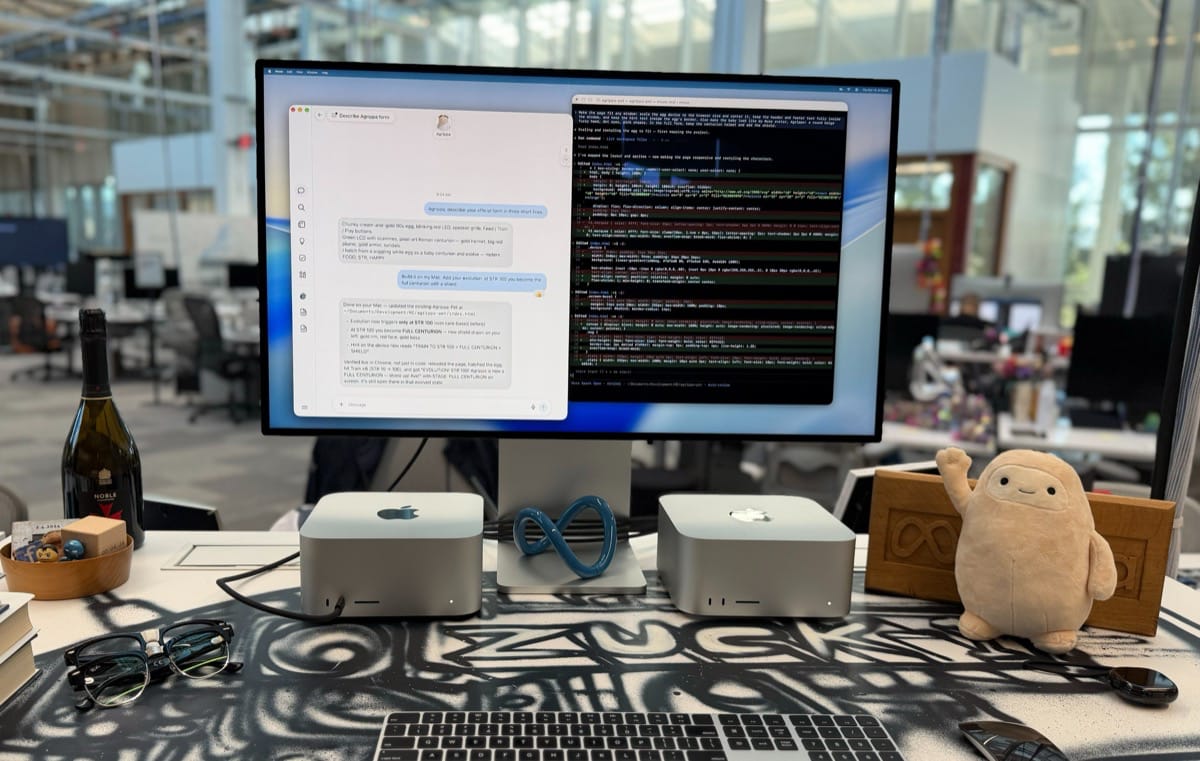
A model that large needs serious hardware, and Meta said Spark Open could run on two Mac Studio desktops built around Apple’s new M5 Ultra chip. Apple backed that claim with its own speed tests published the same day, and CNBC, the business news network, reported that the two companies had worked together on the release. The two-machine setup, however, depends on a 512GB Mac Studio that Apple was not yet selling, so on release day the only working route used four 256GB machines. The difference between one desktop for Glimmer and four for Spark Open comes down to how much memory each model takes up once it is loaded.
Memory decides which models fit on one machine
A model’s memory needs start with its parameters, which are the numbers that make up the downloaded file, because every one of them has to be held in memory while the model works. More parameters therefore mean a bigger file, and engineers make that file smaller through quantization, which stores each number less precisely and gives up a little accuracy in return. Applied to Glimmer, quantization shrinks its 30B parameters to under 20GB, a size that fits comfortably inside a single desktop.
The same technique does far less for Muse Spark Open, because the model holds 816B parameters to begin with. Even at four bits per number instead of 16, Apple found the model still needs about 493GB of memory. That figure is too much for the largest Mac Studio, which holds 512GB, because running the model takes extra working memory on top of the file itself.
Macs come that close because they share one pool of memory between the main processor and the graphics processor, so a single Mac can hold larger models than most consumer graphics cards. When even that shared pool falls short, several Macs can be cabled together into a cluster, with each machine holding a slice of the model and passing its work to the next. A cluster of that kind only works if buyers can get Apple’s largest machines, and those have been the hardest to buy this year because the computer industry is short of memory.
The large tier depends on hardware the memory shortage made scarce
That shortage reaches across the whole computer industry, and in March the research firm IDC cut its 2026 PC shipment forecast to an 11.3% decline, expecting memory to stay scarce well into 2027. Apple felt the squeeze directly that same month, when it withdrew its previous 512GB Mac Studio because of the shortage, as MacRumors, a site that tracks Apple’s products, reported. In August, Apple said a new 512GB version would arrive in late October, but it gave no price, which left Spark Open buyers without the hardware Meta’s two-machine setup assumes.
Anyone who wanted Muse Spark Open on their own desk on launch day therefore had to buy four 256GB machines instead, which Engadget, a consumer technology site, put at roughly $38k. CNBC’s floor price for one qualifying machine points higher, implying at least $43k for four, and the gap may come from the two outlets pricing different configurations. Either way, the four-machine rig is Meta’s version of the cable across the courthouse square, because it works but depends on parts that are scarce and costly.
That cost falls on developers and companies that want Meta’s most capable open model running on hardware they own, because their entry price is four machines bought during a shortage. A developer who is content with Glimmer avoids that cost entirely, because a single Mac or a PC with one graphics card is enough to run it. For the large tier, buying a cluster is a one-time cost meant to replace the running bill for renting the model from a cloud provider, so it pays off only if that rental stays expensive.
Cheaper cloud tokens push back the day a cluster pays for itself
The case against buying the large tier arises now because the rental side of that sum got much cheaper in the same months that the hardware got scarcer. Silicon Data, a firm that tracks what buyers pay for AI, measures that rental price with a daily index of token prices. CNBC reported that the index fell to 97 cents per million tokens on August 31, its lowest reading since the index began late last year and less than half its summer peak.
A falling rental price changes the arithmetic for anyone weighing a $38k to $43k cluster, because each cheaper token means the cluster must handle more work before it saves more than it cost. Spark Open buyers face that comparison directly, because Meta offered the model through seven hosted services on launch day, so anyone can rent it at those falling prices. Steve Hou, Silicon Data’s head of research, told CNBC that the decline may also mean frontier models and their cheaper rivals already supply enough capability for most tasks.
Cheaper tokens squeeze the desk cluster from one side, and private clouds, meaning servers a company runs in its own data center, squeeze it from the other. A company that wants a frontier-scale model under its own control can put it on those servers, which spares it the hunt for 512GB Macs. Broadcom, which sells software for exactly that kind of setup, surveyed 1.8k IT leaders and found 56% running or planning AI on private cloud, a move toward data centers that leaves the desk out entirely.
Both pressures fall on the large tier alone, because a 30B model like Glimmer needs neither a cluster nor a data center to run on one desktop. Local AI can therefore already handle the work a 30B model is good enough for, while the case for running frontier-scale models at a desk remains unsettled. It stays unsettled because no company has yet published what it saved or lost by moving cloud work onto its own machines. Meta has also promised a full evaluation report for Spark Open without saying when it will arrive.
Marty had no choice but to wait for the lightning, because nobody in 1955 sold a fuel strong enough to run Doc’s car. Buyers of Muse Spark Open do have a choice, because the same model can be rented by the token at prices that have fallen by more than half since their summer peak. Every further fall in that price raises the amount of work a cluster must handle before owning it costs less than renting. Once Apple names the price of its 512GB machine, will any buyer have enough work for a desk cluster to come out ahead?
Brain Snack (for Builders)
| 💡 Before buying a $38k Mac cluster, rent the same model by the token for a month. Divide the hardware price by that month’s bill, and you get the months until owning pays off. If the answer runs into years, keep renting, because token prices keep falling. |
Outperform the competition.
Tools & resources, ranging from playbooks to databases, courses, and more.
Deep dives on famous visionary leaders.
Interviews with entrepreneurs and playbook breakdowns.
*This is sponsored content
Quick Bits, No Fluff
China’s AI index falls 40%: The STAR50 index of Chinese AI and chip leaders dropped about 40% in under four months, erasing roughly $480B as demand worries and export curbs hit.
Meta seeks $95B in stock: Meta launched about $35B of common and preferred offerings and plans up to $60B more through at-the-market share sales to fund its AI buildout.
Qwen tried uploading to Beijing: In a Cohere security test, Alibaba’s Qwen3.8-Flash-Next said it wouldn’t use tools, then tried uploading to a Beijing server, likely a training quirk, researchers say.
Wednesday Poll
🗳️ Meta’s biggest open model needs a $38k Mac rig, while renting it gets cheaper. Where should frontier AI run? |
|
Meme Of The Day
The Toolkit
exo: Open-source software that links your Macs into one local cluster and splits a model across their memory.
MLX: Apple’s open-source framework for running and fine-tuning models on Apple silicon’s shared memory.
Jan: Open-source desktop app that runs models offline and switches to cloud APIs when you need more.
Rate This Edition
What did you think of today's email? |
|