Here's what's on our plate today:
🧪 Thomson Reuters built its own $40M AI model to stop renting one.
📰 Europe orders a €387.8M AI supercomputer from Bull; China's IPO boom runs on AI as Shein lists in Hong Kong; quantum computers threaten today's encryption.
💡 Prompt of the Day: decide whether your company should rent its AI or build it.
Let’s dive in. No floaties needed.
Goodies delivered straight into your inbox.
*This is sponsored content
AI is reshaping fraud. It’s time to rethink trust.
AI is changing how fraud shows up and how quickly it can scale. Signals that once worked are easier to spoof, forcing teams to choose between higher losses or more friction.
This white paper explores why traditional identity approaches are breaking down in the AI era and how financial behavior and broader context help teams catch more fraud earlier while maintaining seamless user experiences.
*This is sponsored content
The Laboratory
TL;DR
Thomson Reuters spent $40M to stop paying rent on the smartest part of its own product.
The trigger: A single Anthropic release in January 2026 showed that legal work could be handed to a general model with a few instruction files. Thomson Reuters shares fell nearly 18% in a day.
The real problem: Independent researchers had already caught its Westlaw AI making things up about a third of the time. Renting a better model would never have fixed that.
The bet: Thomson does not have to beat GPT-5.5 or Gemini. It has to be reliable enough and belong to the company selling it.
The complication: Thomson Reuters told a federal court that nobody else may train a legal AI on its content. It then trained one on that content itself.
The stakes: Whether professionals are buying intelligence, which keeps getting cheaper, or verification, which nobody has learned to mass-produce.
Thomson Reuters stopped renting its intelligence
For most people around the world, rent is simple arithmetic: you pay every month, you get to live in the house, and at the end of it you own nothing. Thomson Reuters has been paying that kind of rent for years, on something less visible than a house. The company owns Westlaw, the case law database that most American lawyers use for research, and it sells an AI assistant called CoCounsel that reads and drafts documents for them. But the intelligence inside CoCounsel was never its own. Every answer that assistant produced came from a model licensed from OpenAI, Anthropic, or Google, which meant the customer relationship belonged to Thomson Reuters while the thinking behind it belonged to somebody else.
On August 24, 2026, the company announced Thomson, a large language model trained on decades of its legal, tax, and news archives, with hundreds of in-house lawyers and tax specialists grading the results, at a stated cost of about $40M. Thomson is designed to reduce the company's reliance on the models it had been renting. It did not have to be built from nothing, because Thomson Reuters started with an open-weight model, meaning one whose maker has published its internal settings for anyone to download and modify for free.
At face value, this may sound like another story about the value of proprietary data in the age of AI. However, there is a more interesting message underneath the headline: one of the AI industry's largest customers has decided it can build the thing the labs have been selling it. Thomson does not have to compete with the best models in existence. It only has to be good enough, reliable enough, and controllable enough for Thomson Reuters to stop depending on labs whose pricing and priorities it does not set. Whether that works is, in the end, a question about money, because owning a model only changes the business if it changes the bill. And for Thomson Reuters, the moment that made the bill worth questioning arrived six months before the launch.
The day general AI did specialist work
On January 30, 2026, Anthropic released a set of add-ons for Claude Cowork, its desktop tool for carrying out multistep computer work. One of them handled legal tasks, including contract review and compliance tracking. None of it required a new model, because the whole thing was configuration, or rather a set of instruction files pointing an existing general model at a profession.
Think of it this way. A legal software company sells expertise wrapped in software, and customers pay for the software. If the same work can be produced by writing a few instruction files on top of a model anyone can rent, then the expertise is still worth something, and the wrapper around it is worth considerably less.
Investors did the arithmetic the next trading session. Reuters reported that Thomson Reuters shares fell nearly 18% on February 3, the biggest single-day drop in the company's history. The business itself was in good shape, and the company reported 10% growth from its professional units in its second-quarter 2026 results. What fell was confidence in its ability to keep setting its own prices. Pricing power tends to settle with whoever owns the model underneath, and Thomson Reuters did not own one.
Owning one, however, only helps if the model can do something the rented ones could not. That is where a piece of research from two years earlier becomes relevant.
The accuracy problem came from outside the company
In 2024, researchers at Stanford's RegLab and Yale ran the first pre-registered independent test of commercial legal AI tools. The industry had been telling customers that its products had largely solved hallucinations, which occur when a model states something false with complete confidence, such as citing a non-existent case. The test found otherwise, and Thomson Reuters' own Westlaw AI-Assisted Research hallucinated about a third of the time and was fully accurate on 42% of the questions it was asked.
The finding mattered because it went at the heart of what the company had been selling. Thomson Reuters had been arguing that pointing a general model at trusted content is what makes an answer trustworthy. The research suggested that trusted content is not sufficient on its own, since the model can still invent things on the way to the answer.
Thomson is the attempt to build reliability into the model itself rather than around it. The company's strongest evidence comes from an evaluation of 53 legal research questions written by its own experts. It measured factuality, meaning whether the source cited under a sentence actually supports that sentence, and Thomson scored 0.83, compared with 0.65 and 0.68 for general models searching the open web. That is the score a working lawyer would care about, because the citation under a sentence is the part they have to stand behind.
The evidence carries an obvious limit, since the company wrote the questions and graded the answers using AI judges calibrated against its own experts. No independent study has repeated the test, and the public case for Thomson rests on benchmarks instead, which are less flattering than the announcement.
The company's own table complicates its own claim
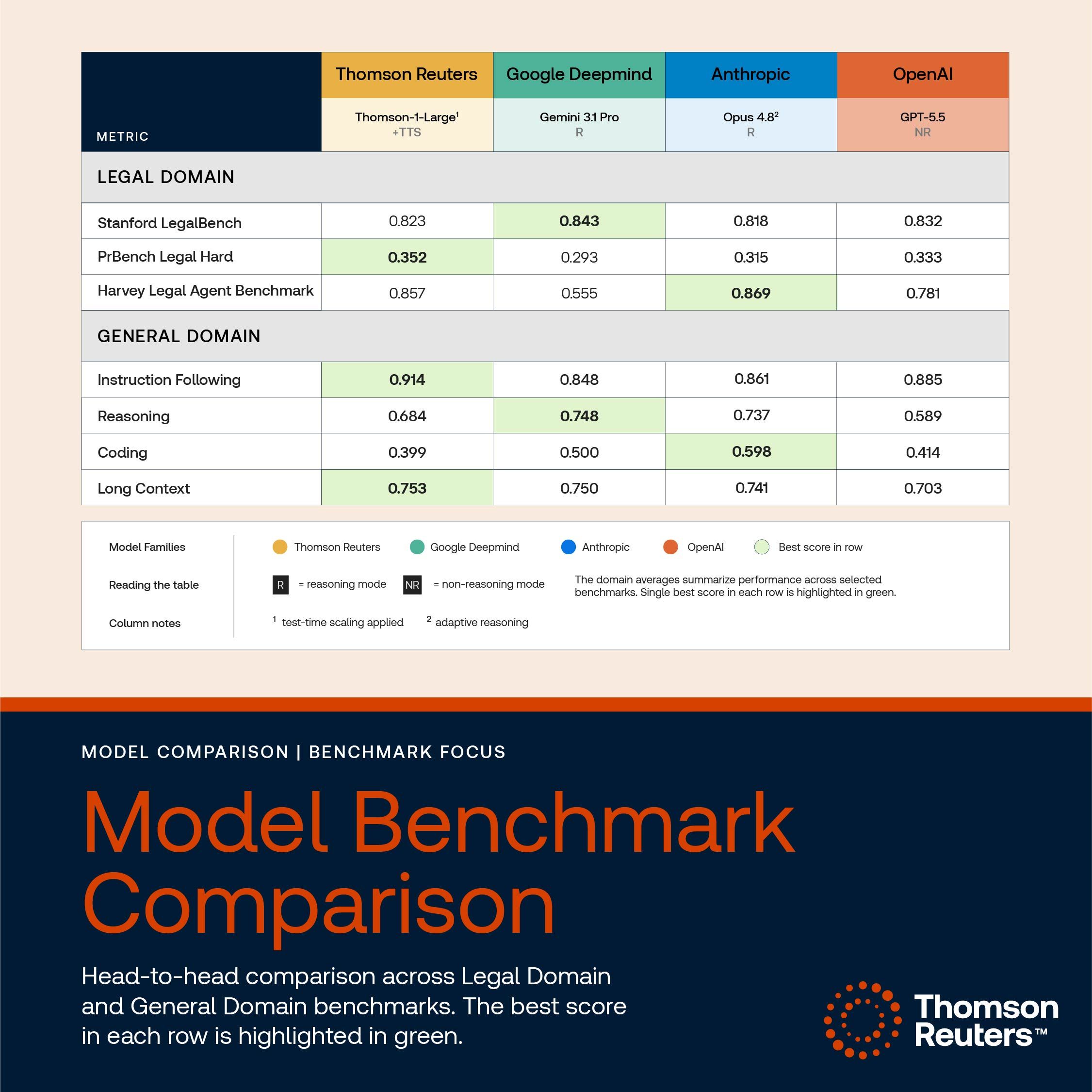
On July 31, 2026, Thomson Reuters published head-to-head results, claiming that Thomson performed competitively with Claude Opus 4.8 and ahead of GPT-5.5 and Gemini 3.1 Pro. Its own table shows a more mixed picture. On Stanford LegalBench, a standard test of legal reasoning, both Gemini 3.1 Pro and GPT-5.5 finished ahead of Thomson. These are a vendor's numbers, chosen and configured by the vendor, and they should be read that way.
None of that sinks the strategy, because the strategy was never to win a leaderboard. A model has to be good enough at the work in front of it, and it has to belong to the company selling it. Thomson Reuters is betting that the second condition is the one nobody else can supply. However, a company made almost exactly this argument three years ago.
Bloomberg already ran this experiment
In March 2023, Bloomberg announced BloombergGPT, a model trained on what its research paper called perhaps the largest financial dataset assembled to that point. The reasoning was the same as what Thomson Reuters uses today: general models cannot replace specialists, and proprietary data is the difference. Within about a year, that argument had weakened, because academic evaluations found that GPT-4 matched or beat it on financial tasks without any access to Bloomberg's data.
Thomson Reuters knows this history, and its answer deserves to be taken seriously. Its research lead argues that raw capability is becoming abundant and cheap, while verifiable reliability is a separate problem, and one nobody is going to solve for law by accident. The company's technical account is candid about the price of that focus, discussing 'catastrophic forgetting', the problem where teaching a model a specialty erodes its general skills. Thomson finished last of four models on coding, which is roughly what that trade looks like when it works.
Thomson Reuters is also claiming something Bloomberg never claimed: independence, and that claim has a more complicated history than the launch suggested. The company's technical post names the base model as Snowdon, built by the FAIR Lab at Imperial College London, which the two founded jointly in December 2025. Business Insider reported on launch day that Snowdon was itself a reworking of Qwen, an open-weight family released by the Chinese group Alibaba, a base Thomson Reuters' own CTO confirmed to the outlet even as he argued the model has been reworked enough that nothing ties it to Alibaba. Open weights are open weights, so none of this undermines the technology, though the independence turns out to have a longer supply chain than the launch implied.
A harder question sits alongside it: what the company trained the model on. Thomson Reuters has spent two years arguing about that exact question in court.
The company argues both sides of one question
In February 2025, a federal judge ruled that Ross Intelligence, an AI legal research startup, had infringed Thomson Reuters' copyright. Ross had asked to license Westlaw headnotes, the short editorial summaries of what a case held, and was refused, so it used them to build a rival research tool anyway. The judge rejected its fair use defense, which argues that a copyrighted work can be reused without permission when the purpose is sufficiently different.
That ruling left the company arguing two things at once. In court, Thomson Reuters says its editorial content is valuable enough that no one else can use it to train a competing legal AI. In its product, it has used the same content to train its own competing legal AI. Both positions are lawful because the company owns the material and Ross did not, and the difference between them is ownership, which is what the entire strategy rests on.
The Third Circuit heard Ross's appeal on June 11, 2026, in the first appellate case anywhere on whether training a model on copyrighted work counts as fair use. The docket shows no decision yet, and until one arrives, the rule that would decide between those two arguments does not exist.
The number that would settle it is missing
What Thomson Reuters has not published is what Thomson costs to run, set against what the company used to pay outside labs. That comparison is the whole business argument, because owning a model only changes the economics if it changes the bill. The model has also been trained on less than 10% of the company's content, so every result so far comes from a system still being built.
For now, Thomson runs one feature, called Tabular Analysis, which reads a stack of documents and pulls the same set of facts out of each one, the way a junior lawyer would build a spreadsheet from 400 contracts, one row at a time. The rest of CoCounsel still runs on rented models, and an administrator can switch Thomson off from the settings. Whether that switch stays there depends on a question nobody has answered yet: are lawyers paying for intelligence, which gets cheaper every quarter, or for verification, which nobody has worked out how to mass-produce?
Prompt of the Day
| 💡 Act as a strategy analyst. Decide whether my company should keep renting a frontier model or train its own, and specify the annual spend, the reliability bar it has to clear, the switching risk, and the volume at which owning starts to pay. |
The context to prepare for tomorrow, today.
*This is sponsored content
Tuesday Poll
🗳️ Thomson Reuters spent $40M to own its AI instead of renting it. Does that bet pay off? |
|
Bite-Sized Brains
Europe buys its own AI compute: EuroHPC picked French state-owned Bull to build LUMI-AI, a €387.8M ($449.4M) system in Finland that will lift the region's AI capacity tenfold.
China's IPO boom runs on AI: Shein's $1.7B Hong Kong debut lands in a listing rush that already sent memory chipmaker CXMT up 466% and robot maker Unitree up 460% on day one.
Quantum's second edge: The same machines being built to speed up drug discovery and financial modeling could break the encryption protecting most of the internet.
The Toolkit
Deepgram: Speech-to-text API built for scale, handling real-time transcription and voice intelligence for production apps.
Dust: No-code platform for building custom AI agents that connect to your company's tools and data.
Chroma: Open-source vector database built for AI apps, fast to set up and easy to scale for RAG and embeddings.
Rate This Edition
What did you think of today's email? |
|












.svg)
.svg)