Here's what's on our plate today:
🧪 Why AI's biggest payoff may be hiding inside ordinary products.
📰 OpenAI loses its No. 2, Meta commits C$13B in Alberta, Anthropic puts a meter on Fable 5.
⭐️ Roko's Pro Tip: judge AI by the products it quietly improves, not the demos it loudly runs.
📊 Poll: If AI's value hides inside everyday goods, who actually captures it?
Let’s dive in. No floaties needed.
Meet your next hire in as little as five days
Sponsored by

What’s next is almost here.
On July 16th at 1PM ET, beehiiv is going live with a look at the future of publishing, audience growth, and digital business.
What started as a newsletter platform has evolved into something much bigger: a place where creators and brands can grow, monetize, and own their audiences without stitching together half the internet to make it work.
Join us to see what’s coming next.
*This is sponsored content
The Laboratory
TL;DR
AI's most important act might be the one nobody claps for: quietly rewriting the recipe.
From ad copy to formula: at the Consumer Goods Forum in Vienna, L'Oréal, Mondelez, and others revealed that AI has moved from marketing into product design itself, claiming faster development and better recipes on cost, nutrition, and sustainability.
The invisible economy: McKinsey pegs AI's potential value to retail and consumer goods at $400B to $660B a year, built from tiny gains across millions of products rather than one breakthrough.
The credibility gap: MIT's NANDA study found roughly 95% of enterprise generative-AI pilots show no measurable profit impact, and the vendors define their own success metrics.
What's at stake: if AI becomes invisible infrastructure like electricity, its biggest payoff hides inside ordinary products, making its true economic weight nearly impossible to measure or verify.
Why AI's biggest payoff may be hiding in your shampoo & cookies
For most of human history, the inventions that changed civilization were rarely the ones with the most obvious first act. Their real importance lay in becoming the foundation on which countless other innovations were built. The steam engine made industrialization possible. The transistor enabled modern computing. The internet eventually rewired commerce, communication, and entertainment. Their greatest contribution was not what they did themselves, but what they allowed everyone else to do. Artificial intelligence may be entering that same phase.
For the past three years, the public conversation around AI has been dominated by the spectacular: chatbots that write essays, models that cost billions of dollars to train, and humanoid robots performing carefully choreographed demonstrations on brightly lit stages. Far less attention has been paid to the industries that make the ordinary products people buy every week, from the shampoo in their shower to the cookies in their cupboard.
Those companies have been grappling with a very different reality. Growth has slowed, consumers have traded down to cheaper brands, and tastes have begun shifting faster than global supply chains can adapt. Even L'Oréal, the world's largest cosmetics company, spent 2025 recovering from its slowest sales growth in years. Despite generating €44.05B in annual revenue, the company unveiled what its chief executive called a "beauty stimulus plan" to accelerate innovation and push more products out of its laboratories.
It was against this backdrop, rather than inside the frontier AI labs that usually dominate headlines, that consumer goods executives gathered in Vienna in late June to discuss a different vision of AI: not as a headline-grabbing technology, but as a tool quietly reshaping how everyday products are designed, tested, and brought to market.
Until then, much of this transformation had unfolded behind closed laboratory doors, buried inside corporate R&D teams rather than showcased at AI conferences. When consumer goods executives finally spoke publicly about what they had been building, they revealed something more significant than another corporate AI deployment. They suggested that AI had begun changing the products themselves.
The disclosures from Vienna
The account that reached the public came from Reuters on July 6, 2026, reporting from the Consumer Goods Forum's Global Summit that household brands were using AI to reinvent the actual composition of everyday goods. The most concrete example came from L'Oréal, whose consumer products president, Fabrice Megarbane, said the company had used AI to identify molecules in its skincare products that could be repurposed for shampoo, and that it could now create products four times faster than before.
That capability had already reached supermarket shelves as a collagen shampoo sold under the Elseve label, marketed on its ability to add volume. At Mondelez, the owner of Cadbury, Oreo, and Chips Ahoy, the chief information and digital officer, Filippo Catalano, called AI-augmented product development a "game-changer" and said it had helped produce a gluten-free Golden Oreo and a reworked Chips Ahoy recipe, with the company reporting that 60% of the biscuit recipes its AI tool generated outperformed the human versions on nutrition, cost, and sustainability.
On their own, these announcements could be dismissed as isolated corporate success stories. Taken together, however, they point to a shift in which AI is beginning to create value inside consumer businesses.
From the storefront to the laboratory
What separates these disclosures from the past several years of corporate AI enthusiasm is where the technology has moved. For most of that period, AI in consumer goods meant marketing: generating advertising copy, personalizing recommendations, and dressing up campaigns, all of it sitting on the surface of the business where customers could see it. The Vienna descriptions place AI somewhere far less visible, inside the formulation itself, in the choice of which molecules to combine and which recipes to test.
Catalano framed the change as one of compression, with work that once took months now taking weeks and work that once took years now taking months, which describes the speed of narrowing millions of possibilities down to the few worth mixing in a real lab rather than any claim of machine invention. The center of gravity is shifting from the storefront to the back office, into research and operations, the least glamorous and most economically important parts of the enterprise.
That shift has implications far beyond consumer goods. Once AI becomes embedded in how products are designed rather than simply how they are sold, its economic impact becomes much harder to see, and potentially much larger.
The invisible economy
This is where the story stops being about cookies and starts being about the shape of the whole AI economy. The dominant expectation has been that AI would announce itself through visible, standalone products that people choose deliberately, as they once chose a smartphone or a search engine. The consumer goods case points toward a different destination, one in which the technology dissolves into the background, with products that carry no AI branding at all, improving each by a margin too small to notice on its own, yet, multiplied across thousands of products and billions of purchases, becoming economically significant.
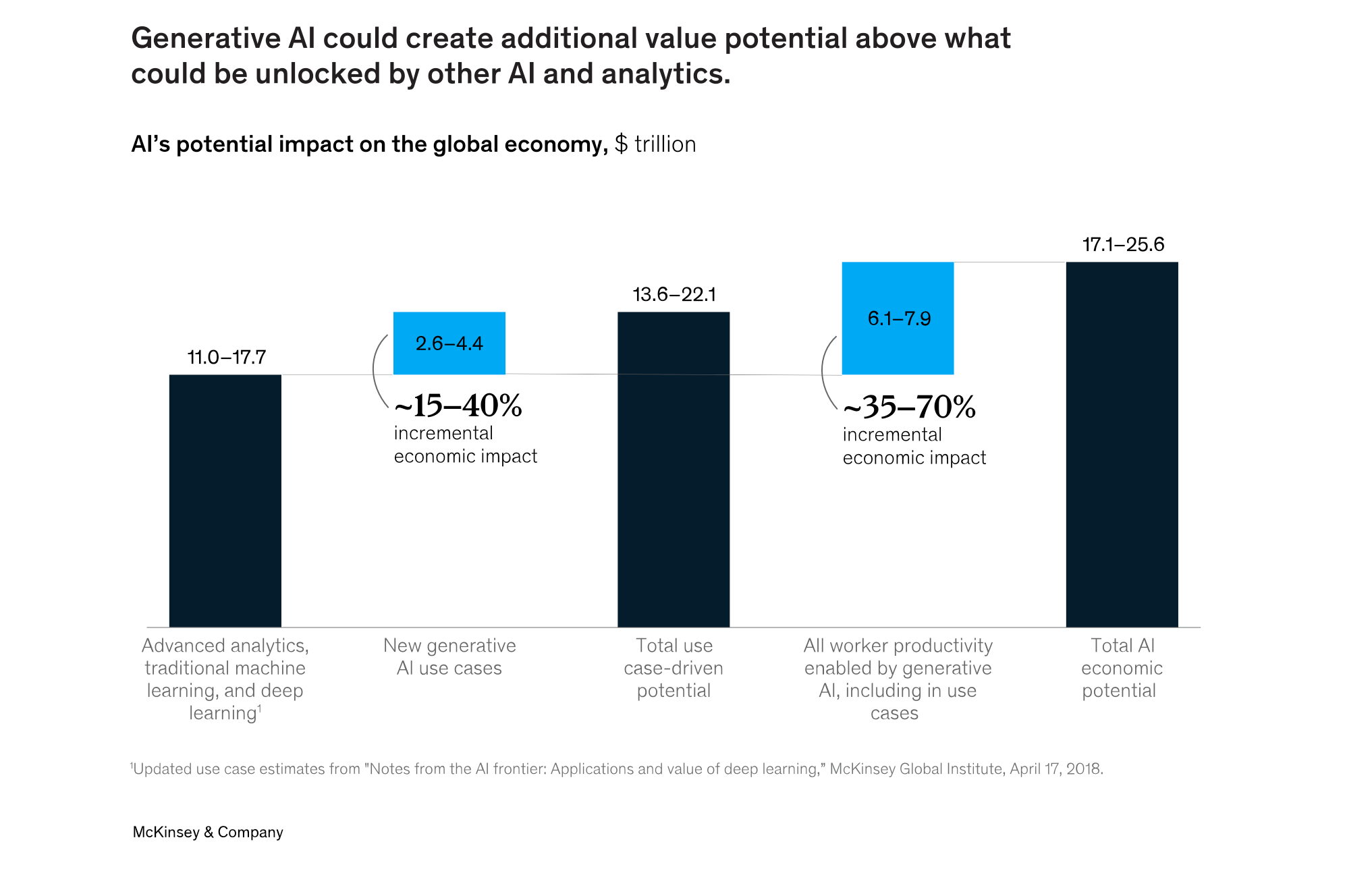
McKinsey has estimated that generative AI could eventually add $400B to $660B a year in value to retail and consumer packaged goods, a projection that rests on exactly this kind of diffuse, cumulative improvement rather than a single breakthrough. The complication is that the same broad economy shows very little of that value so far, since a widely cited study from MIT's NANDA initiative found that roughly 95% of enterprise generative-AI pilots produced no measurable impact on profit or loss, and named consumer and retail among the sectors with little structural change. The optimistic projections and the disappointing results describe the same technology, and the consumer goods giants are wagering that the distance between them is a matter of time rather than substance. Whether that wager succeeds depends on several assumptions that remain far from settled.
What complicates the bet
Several forces stand in the way of that wager, and they have less to do with the science than with the systems the science has to pass through. For one, the headline numbers come from the companies making the claims. Without disclosed baselines or independent audits, figures such as ‘four times faster’ or ‘60% better’ point to real internal improvements, but outsiders have little way of judging how meaningful they are. Faster product development also does not automatically produce better products. It can just as easily lead to more variations, more shelf clutter, and more launches that ultimately fail.
The technology could also widen the gap between industry leaders and everyone else. The molecular simulation platform that L'Oréal developed with NVIDIA relies on proprietary datasets and significant computing power, resources that large incumbents can afford far more easily than smaller rivals. Rather than lowering barriers to entry, AI could reinforce the advantages of companies that already dominate the market.
There are also questions about the long-term impact on scientific expertise. Much of the repetitive work involved in early-stage formulation has traditionally served as a training ground for junior researchers. As AI automates more of those tasks, companies may eventually need to rethink how the next generation of scientists develops the experience and intuition that today comes through practice.
Finally, regulation has yet to catch up. Food, cosmetics, and consumer health products already operate under strict safety and labeling rules, yet companies are generally not required to disclose whether AI played a role in developing a formulation. Policymakers in both Europe and the United States have only begun grappling with whether that should change.
An old paradox returns
The deeper question here predates the current wave of technology by decades. In 1987, the economist Robert Solow observed that you could see the computer age everywhere but in the productivity statistics, capturing a moment when businesses had spent heavily on information technology while the promised gains stubbornly refused to appear in the data, only to arrive years later once companies reorganized themselves around the new tools. That pattern is being invoked again, with analysts noting that AI is visible across corporate life yet largely absent from the macroeconomic numbers. The consumer goods experiment amounts to a live test of whether the technology follows the same delayed arc that electricity and computing did, becoming an invisible general-purpose utility whose value shows up quietly and late, distributed through the ordinary business of making and selling things rather than captured in any product a person could hold up as the moment everything changed.
The credibility of the claims rests partly on how far the underlying science has already come. When Google DeepMind predicted the structures of 2.2M new materials in 2023, roughly 380k of them stable enough to be worth making, it showed that AI could explore the space of matter faster than human trial and error, and the formulation engines now sitting inside a shampoo lab are the mass-market descendants of that frontier work. The difference lies only in ambition, the same predictive machinery aimed not at a superconductor but at a cookie that costs slightly less to make and a shampoo that reaches the shelf slightly sooner.
The history of general-purpose technologies is also the history of disappearance. They begin as remarkable inventions and end as invisible infrastructure, so deeply embedded in everyday life that their presence no longer warrants mention. If artificial intelligence follows that pattern, the defining chapter of the AI era may not be written by the companies building ever-larger models, but by those quietly using them to improve everything else. The shampoo, the cookie, and thousands of other ordinary products may never advertise that an algorithm helped create them. Like the steam engine, the transistor, and the internet before it, AI's greatest achievement may be that it eventually stops looking like a technology at all.
Roko Pro Tip
| 💡 The AI worth betting on rarely shows up on a stage. Before you chase the flashiest launch, ask a quieter question: which of the things you already buy or build got a little cheaper, faster, or better this year, and did anyone tell you why? The real payoff is starting to hide in ordinary products, and the companies that measure that hidden gain will outcompete those still counting demos. |
Outperform the competition
Tools & resources, ranging from playbooks, databases, courses, and more.
Deep dives on famous visionary leaders.
Interviews with entrepreneurs and playbook breakdowns.
*This is sponsored content
Bite-sized Brains
OpenAI loses its No. 2: Fidji Simo is stepping down from her full-time CEO of Applications role to a part-time advisory seat after an extended medical leave, leaving Sam Altman hunting for a successor just as OpenAI eyes a possible IPO and races to close the enterprise gap with Anthropic.
Meta plants its biggest flag abroad: Meta broke ground on a C$13B ($9.17B) data center in Sturgeon County, Alberta, its first in Canada and largest outside the US, a 1-gigawatt site scalable to 1.8GW, a concrete marker of how fast the AI compute land grab is spreading.
Anthropic puts a meter on Fable 5: Claude Fable 5 shifted from subscriptions to pay-per-use at $10 and $50 per million input and output tokens, double Opus 4.8, and the priciest model Anthropic has ever listed, blamed on compute shortages, with backlash pushing free access out to July 12.
Monday Poll
AI is moving from the storefront into the formula itself, improving products by margins too small to notice. If that's where the value now lives, who captures it? |
|
Meme Of The Day
The Toolkit
Mirage: AI video generator that turns prompts or photos into cinematic clips with multimodal foundation models.
Speechmatics: Speech-to-text engine built for accuracy across accents, noisy audio, and real-time use.
Superhuman: AI-powered email client that drafts replies, summarizes threads, and gets you to inbox zero faster.
Rate This Edition
What did you think of today's email? |
|









.svg)
.svg)