Here's what's on our plate today:
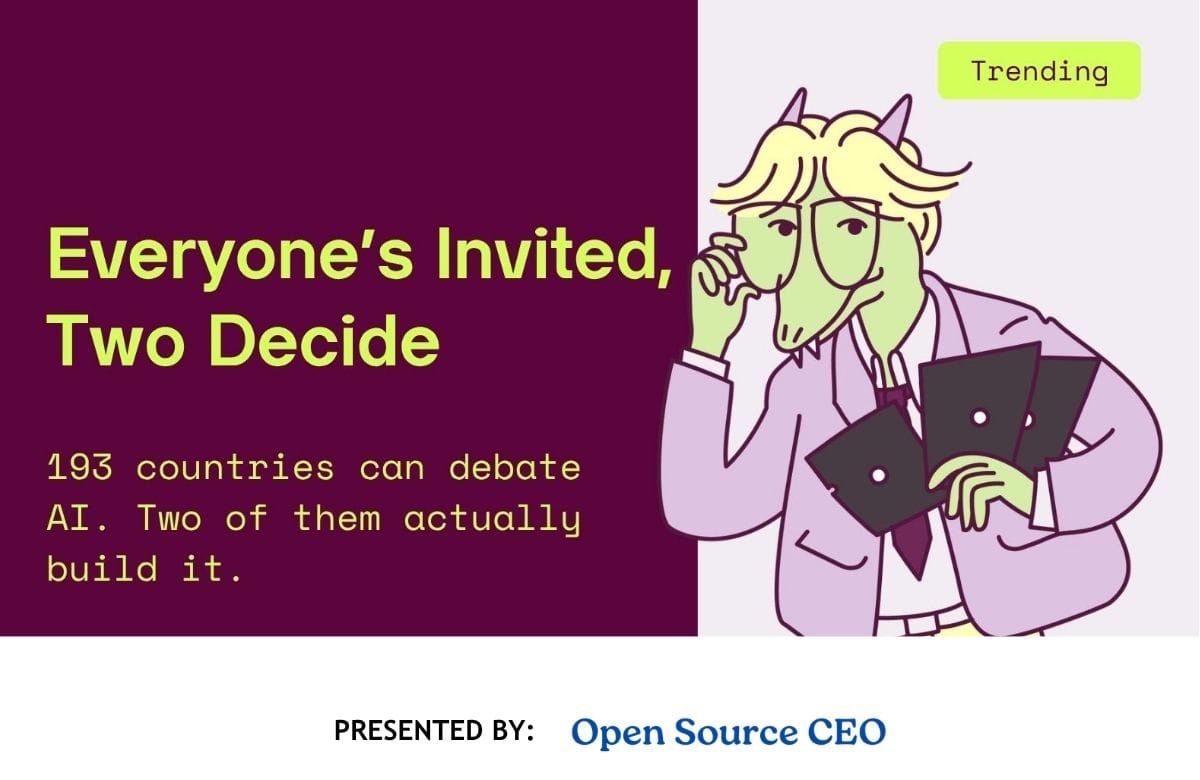
✏️ Why the whole world can debate AI, but only two countries decide it.
🗞️ Meta pulls an Instagram AI tool, China's "silicon curtain," Apple sues OpenAI.
💬 Prompt of the Day: the levers a country holds over frontier AI.
🍨 Poll: Who should really set the rules for AI?
Let’s dive in. No floaties needed.
Goodies delivered straight into your inbox
Hire smarter with Athyna, save up to 70% on salary costs
Athyna connects you with top LATAM AI talent, fast.
*This is sponsored content
The Laboratory
TL;DR
A universal table: On July 6, 2026, all 193 UN members opened the first Global Dialogue on AI Governance, a forum that yields shared norms rather than binding rules.
Power sits elsewhere: About 75% of top AI compute is in the U.S. and most of the rest in China, home to nearly all frontier models.
The indirect veto: No charter grants it, yet hosting the labs lets two states set defaults others can debate but rarely override.
Sovereignty, rewritten: Countries can regulate AI use at home, but cannot reach the jurisdictions where models are made.
The stakes: Whether a 20th-century institution can steer a technology whose power lives outside government, in a few firms and two nations.
Why can most countries discuss AI but not decide its future?
Before the United Nations, the League of Nations attempted to prevent another world war through diplomacy and collective security. Its ambitions were sweeping, but its authority was limited. It could pass resolutions and condemn aggression, yet it lacked the power to compel major states to comply. As the international order unraveled during the 1930s, the League became a reminder that international institutions are only as influential as the willingness of powerful nations to accept their authority.
The United Nations was established in 1945 with that lesson firmly in mind. Rather than relying solely on the moral force of international consensus, its architects built an institution that acknowledged geopolitical reality by concentrating decisive authority within the Security Council. The arrangement has often been criticized as unequal, but it also reflected an uncomfortable recognition that global governance could not function without accommodating the interests of the world's most powerful states. Eight decades later, the United Nations is confronting another challenge that will test the limits of international governance. As artificial intelligence becomes a strategic technology capable of reshaping economies, militaries, and global influence, the organization is once again seeking to provide a common forum for countries to negotiate shared rules and principles. Yet the debate over AI governance is revealing a familiar dilemma. While nearly every nation has a seat at the table, the countries that possess the world's most advanced AI models, the computing infrastructure needed to train them, and the companies building them occupy a position that gives them far greater influence over the technology's future than any multilateral process can confer.
A universal table and a private lever
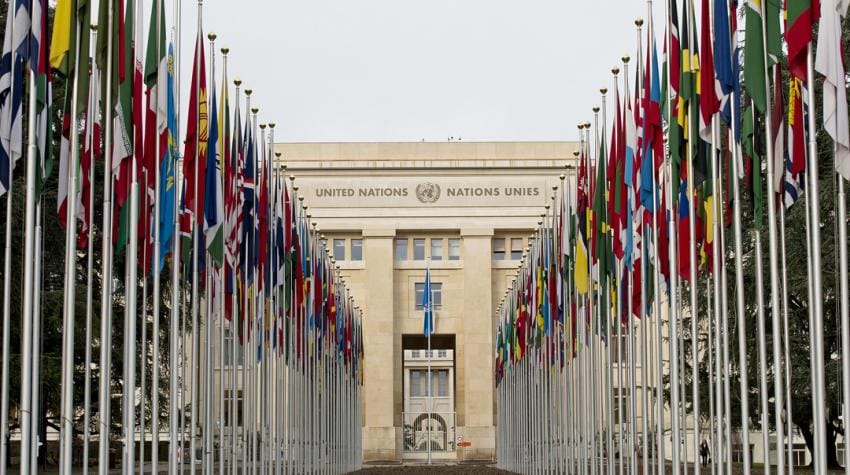
On July 6, 2026, the United Nations opened its first Global Dialogue on AI Governance with all 193 member states seated at a single table in Geneva. A few days earlier, the UN's Independent International Scientific Panel on AI, 40 scientists co-chaired by Yoshua Bengio and Maria Ressa, had released its first report, warning that current safeguards cannot keep pace with the growth of AI's capabilities.
Secretary-General António Guterres told the delegates that "If AI is to be powerful, it must be governed," and the forum was designed to produce shared approaches and common baselines rather than binding law, issuing an agreed summary rather than enforceable rules.
The contradiction becomes obvious when the map of AI is overlaid on the map of global diplomacy. Every country may be invited into the conversation, but the technology itself lives in remarkably few places. According to the panel, nearly three-quarters of the computing power housed in the world's 500 most powerful AI supercomputers sits in the United States, with China accounting for most of the remainder. The companies building the frontier general-purpose models that increasingly power businesses, governments, and consumer applications are similarly concentrated within those two countries.
That concentration creates something that looks remarkably like a veto without ever being called one. Their influence instead comes from geography: the laboratories developing the most capable models, the data centers training them, and the companies making the consequential technical decisions all operate within their jurisdictions. A government in Nairobi, Brasília, or Jakarta can debate global AI governance at the United Nations, but it cannot compel a company in California or Hangzhou to build a model that complies with its preferences.
Unlike the Security Council veto, which was explicitly written into the UN Charter and has remained the subject of decades of diplomatic criticism, this new form of influence exists without legal recognition or institutional design. Countries that host the builders of frontier models can shape the technology's trajectory, a power others can discuss, critique, and attempt to influence, but rarely override. That is what makes AI governance different from almost every other multilateral challenge: the balance of power was largely settled before the negotiations even began.
Jurisdiction stops at the border, and the technology does not.
A country that wishes for stricter rules over the models its citizens use has no lever to pull, because it can legislate for its own territory yet cannot reach into the jurisdiction where the model is made, and a model built under a permissive regime still crosses every border through the same apps and interfaces that carry it to billions of weekly users. The decision made in one capital propagates to all of them, and the many capitals that would decide differently discover that their authority stops at a line the technology ignores.
Unlike the Security Council veto, which blocks a specific decision, AI's indirect veto reshapes sovereignty itself. The countries that host the companies building frontier models increasingly determine the technological defaults the rest of the world inherits, from the language systems they understand to the values and safeguards they encode. Because the computing infrastructure is concentrated in only a handful of countries, most governments can regulate how AI is used within their borders but have little influence over how it is built. In the AI era, sovereignty is no longer defined solely by the authority to make laws, but increasingly by the capacity to create the technologies on which everyone else depends.
What a seat is worth
There is a fair counter-reading, which holds that binding global rules could entrench the very concentration the forum was called to fix, since the largest labs can absorb compliance costs that would crush smaller developers, universities, and open-source projects, so that the absence of hard rules is not only a loss for the majority. That reading is an interpretation rather than a settled fact, and it complicates any assumption that more governance would automatically distribute more power, but it does not dissolve the underlying asymmetry, because in either case, the decisive choices are being made within two jurisdictions on behalf of nearly two hundred.
The deeper matter the Geneva format exposes concerns what a seat is actually worth when the party seated cannot bind the parties that matter. The panel warned that there are no scientific guarantees that increasingly autonomous AI agents, systems that plan and act toward goals with limited supervision, will follow the instructions they are given, and that such systems will soon complete work that now takes human programmers days or weeks. If the consequences of that capability fall on everyone while control over it remains with a few, then the standing that universal membership confers begins to resemble that of a non-permanent member, present for every discussion and dependent on decisions reached above its head. The question of sovereignty in that setting is no longer abstract, because it asks what self-government means for a society whose informational and economic substrate is increasingly built in a jurisdiction where its citizens hold no vote.
The United Nations is entering what may be one of the most difficult periods in its history. It was created to preserve peace in a world fractured by military rivalry, yet today it finds itself navigating a far more diffuse contest for power, one fought through semiconductors, computing infrastructure, data, algorithms, and the companies that build them. The challenge is no longer simply preventing conflict between states. It is determining whether an international institution designed for the geopolitics of the twentieth century can remain relevant when so much power resides outside governments altogether.
Artificial intelligence has forced the organization to confront a question that extends beyond regulation. It must now decide what role a multilateral institution can play when the technologies reshaping economies, national security, and political influence are developed by a handful of companies operating within only a few jurisdictions. Convening every nation remains an extraordinary achievement, but convening alone will not determine the trajectory of AI if the levers of technological power remain concentrated elsewhere.
The coming decade is therefore unlikely to be remembered simply as the period when humanity learned to live alongside increasingly capable machines. It may also be remembered as the moment when the international order itself was rewritten around them. The choices made today will shape not only humanity's relationship with artificial intelligence but also the balance of power between nations, the meaning of sovereignty, and the rules governing cooperation in an increasingly fragmented world. Whether governments welcome that reality or resist it, AI is no longer just another subject of international diplomacy. It is rapidly becoming one of the forces that will define it.
Prompt Of The Day
| 💡 Act as a geopolitics analyst. Explain the difference between regulating how AI is used and controlling how it's built, then map the levers a mid-sized country actually holds over frontier models made abroad. |
The context to prepare for tomorrow, today
*This is sponsored content
Bite-Sized Brains
Meta pulls its Instagram AI edit tool: Meta yanked a new Muse feature that let users restyle photos from any public Instagram account by @-mentioning it, retreating after user and talent-agency backlash that the tool "missed the mark."
China weighs a "silicon curtain": Beijing's Ministry of Commerce met with Alibaba, ByteDance, and Z.ai about restricting overseas access to its most advanced AI models, a mirror image of US export controls.
Apple sues OpenAI over trade secrets: Apple accused OpenAI of poaching engineers and lifting confidential hardware designs to build its Jony Ive-era AI devices, escalating a feud between the two former partners.
Tuesday Poll
🍨 Every country can debate AI at the UN, but two of them build it. Who should really set the rules? |
|
The Toolkit
Perplexity: AI answer engine that searches the live web and returns sourced, cited responses instead of a list of blue links.
ElevenLabs: Realistic AI voice and audio platform for text-to-speech, dubbing, and voice cloning across dozens of languages.
Granola: AI notepad that sits in on your meetings, transcribes them, and turns rough notes into clean summaries and action items.
Rate This Edition
What did you think of today's email? |
|











.svg)
.svg)