Here’s what’s on our plate today:
🧪 Streaming apps use AI labels to decide who gets heard.
🗞️ Meta drops scraping terms; investors challenge Nscale’s IPO; Microsoft exits Nscale deal.
🧠 Brain Snack: build the appeal path before a detector penalizes users.
Let’s dive in. No floaties needed.
Framer: The AI canvas for the web
Framer is the AI website builder for teams that care about every detail. Agents work directly in the canvas, helping design pages, manage CMS content, write copy, add SEO, and audit sites.
Build faster: Create, refine, and publish production-ready pages in minutes.
Scale confidently: Manage content, localization, and metadata across your site.
Stay in control: Review every change, collaborate in real time, and publish when ready.
Trusted by teams at Miro and Perplexity
*This is sponsored content
Business and tech news. One visual per story. Three minutes.
Bay Area Times is the free daily newsletter that gets business and tech leaders up to speed before their first meeting.
AI, startups, robotics, biotech, energy, and the wider innovation economy, each story paired with one clear visual so you see the point instead of digging for it.
Monday to Friday, three minutes, no noise. More than 250,000 founders, operators, and investors already read it.
*This is sponsored content
The Laboratory
TL;DR
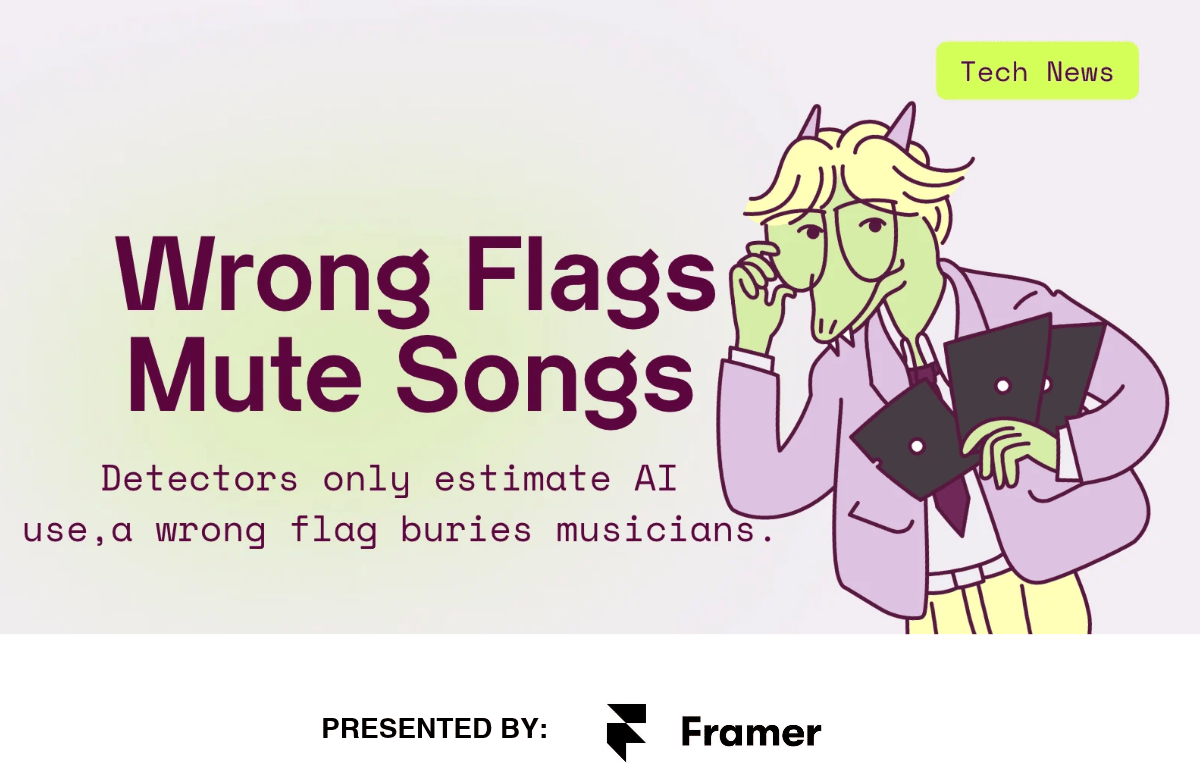
An AI label started as a note to listeners and is turning into a rule about who gets heard.
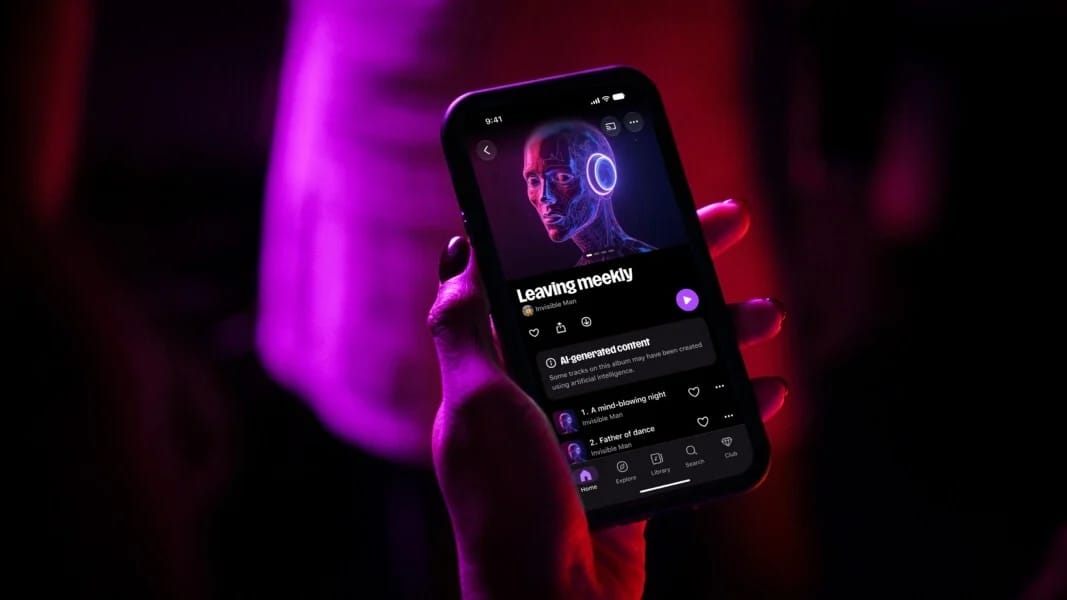
The launch: on October 14, 2026, YouTube Music began labeling songs made mainly with generative AI, one day after Deezer let users hide AI music from search.
The judgment: each label is built from distributors’ own declarations and the platform’s detection tools, which give a probability, not proof.
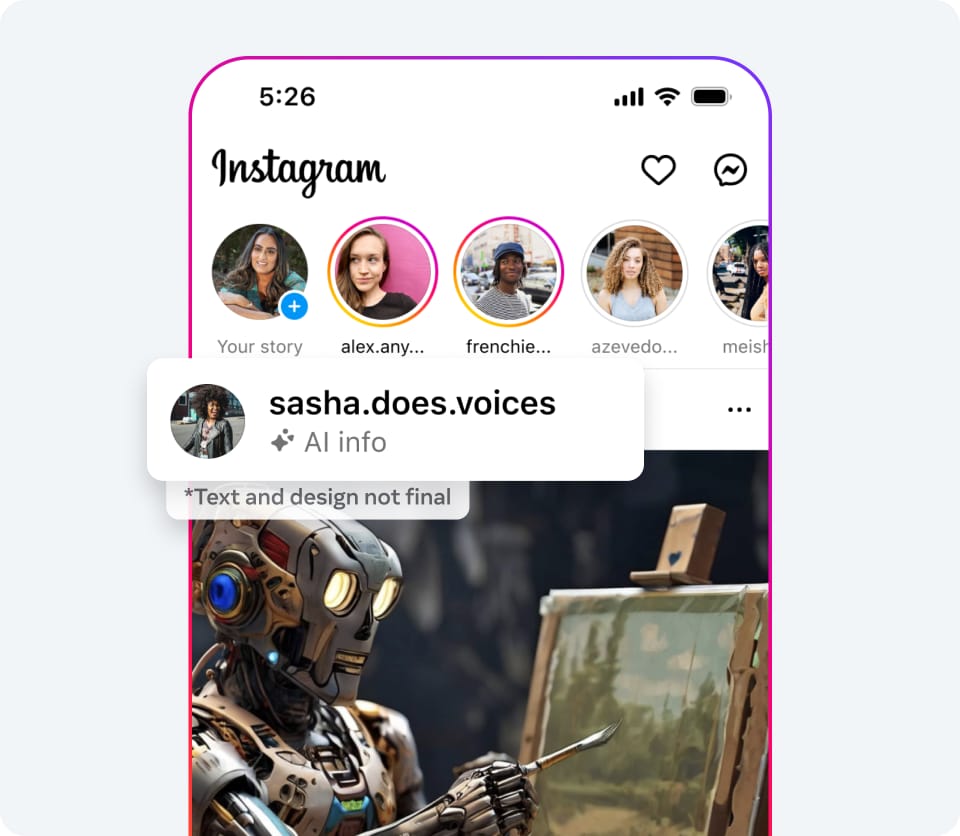
The shelf rule: Deezer drops AI tracks from recommendations, Spotify keeps AI Persona artists out of recommendations by default, and Instagram cuts reach for AI accounts that skip the label.
The flaw: labels also lower trust in human-made work, miss much of the AI content out there, and can wrongly mark a real musician.
The stakes: if YouTube ties its label to recommendations, a disclosure form becomes the gate between a song and its audience.
What AI music labels are & why they now decide who gets heard
In 1985, a group of parents in Washington, D.C., decided that pop and rock records had become too explicit for their children, and they wanted record companies to put warning labels on albums with sexual or violent lyrics. The group, called the Parents Music Resource Center, was co-founded by Tipper Gore, whose husband, Al Gore, was then a senator, and on September 19 that year it took its case to a Senate hearing. Gore told the senators that labeling was “little more than truth in packaging,” because without it parents had no way of knowing which records to keep from their children. Two months later the record industry agreed to a voluntary sticker reading “Parental Advisory: Explicit Lyrics,” which record companies would print in the bottom-right corner of the albums they chose to mark.
The sticker was meant only to inform parents, but some of the country’s biggest retailers turned it into a rule about what they would sell. Wal-Mart, which built its image on family values, refused to stock any album carrying the sticker, and PBS NewsHour reported that the policy changed how the recording industry did business. Record companies wanted their albums on Wal-Mart’s shelves, so they began releasing two versions of explicit records, a cleaned-up one for Wal-Mart and other big chains and the original for everyone else. A notice written for the people buying music had become the test that decided which music reached the store’s shelves.
Streaming services have started putting a similar notice on music made with AI, usually a small badge beside a song telling listeners that a machine produced it. That badge is now following the path the sticker took, because streaming services and social media apps are using it to decide which songs and accounts get recommended, shown in search results, and paid. Once a label decides those things, the question of who receives it, and how accurately, becomes a question of whose music gets heard.
An AI label is a judgment built from declarations and guesses
Before a badge can appear under a song title, someone has to decide that AI was involved, and platforms make that decision in three ways: the uploader declares it, the platform’s own detection software estimates it, or a record stored inside the file proves it. YouTube’s system relies on declarations from distributors and its own detection tools. Record companies and distributors, the firms that deliver songs to streaming services on artists’ behalf, can declare each song “Fully Gen AI,” “Partly Gen AI,” or “No Gen AI” when they send it through DDEX, the music industry’s standard format for delivering songs and their details. YouTube’s Help Center says partners decide for themselves what those categories mean, which means two companies could describe the same kind of song differently. YouTube can add its own signals to their answers or fill in missing ones with its own detection, a model trained to estimate whether something sounds machine-made, and that model produces a probability rather than proof.
The music labels build on a change YouTube made to its videos earlier this year. From 2024, YouTube relied on creators to say when they had used AI, but in May it began labeling videos automatically whenever its systems spotted AI-made footage that looks real. It also made the label permanent for videos carrying C2PA records showing that AI made the whole thing. C2PA, short for the Coalition for Content Provenance and Authenticity, is an industry standard for signed records that travel inside a file and show how it was made.
Platforms are using the label to ration attention and royalties
Platforms moved from trusting uploaders to checking for themselves because of the sheer number of AI songs now arriving. AI has sharply cut the time, money, and effort it takes to make a song, which means a single uploader can now put out far more tracks than a musician working without it. A bigger catalog does not mean people listen to more music, though, and it brings a streaming service no extra money from the subscriptions and advertising it uses to pay artists. Services that pay for each play divide that pot among everyone whose songs were played, so every play that goes to an AI track leaves less for musicians who made their songs themselves. Musicians who earn less can afford to make less music, and a service that fills up with songs few people want to hear risks becoming harder to sell to the listeners and advertisers who keep it running.
The scale of that flood shows in figures from Deezer, the only service that regularly publishes what its detector finds, which reported nearly 90k songs a day made entirely by AI at its June 2026 peak, above 50% of everything uploaded and up from 10k a day in January 2025. Both numbers come from Deezer’s own detector and cannot be checked independently. Listeners cannot sort this out by ear, because a survey by the polling firm Ipsos, paid for by Deezer, found 97% could not tell AI music from music made by people.
Deezer’s answer is to use the label the way Wal-Mart used the sticker, so it removes detected AI tracks from recommendations and from playlists its editors put together. Spotify does something similar with its AI Persona badge, announced August 11, which marks artists whose identity is AI-made and keeps them out of recommendations by default, according to the electronic music publication Resident Advisor. TIDAL goes further on money, saying in June it would tag fully AI-generated tracks and stop paying royalties on them. Instagram applies the rule in reverse, because it cuts the reach of accounts that skip the label while accounts that carry it keep theirs.
The number of AI songs uploaded and the amount of listening they win are two separate problems, because Deezer says AI tracks draw only 1% to 3% of streams despite making up as much as half of what arrives each day. Few real listeners choose these songs, so the money at risk comes mostly from fake listeners, a practice called stream fraud, where bots play AI tracks to take a share of the pot that would otherwise go to human musicians.
The same rule that protects human musicians can also hit them, because detection software sometimes marks human work as AI. That has already happened with photos, when Meta renamed its “Made with AI” label in 2024 after real photos were mislabeled because editing software had marked them as AI-edited. On a service where the label now removes a song from recommendations, the same kind of error would cost a musician an audience.
The strongest objection is that labels are too blunt for this job
Researchers who study labels argue they cannot carry the weight platforms are putting on them. The clearest evidence comes from studies of news headlines, where Sacha Altay and Fabrizio Gilardi found in a peer-reviewed study of nearly 5k people that readers took “AI-generated” to mean a machine had made the whole thing, so the label lowered their belief even in true headlines written by people. Gilardi has argued that platforms should flag harmful content instead of flagging AI content as such, because an AI label tells readers how something was made without telling them whether it is true or harmful.
The labels also miss a great deal of AI content, which weakens the case for relying on them. Meta’s Oversight Board, an independent body Meta funds to review its decisions, found that the company relies heavily on users to declare AI use and labels the content made by its own AI tools inconsistently. The records stored inside files are fragile too, since a peer-reviewed study notes that a screenshot removes C2PA records entirely, so a copy of an AI image can travel without any proof of where it came from.
The objection is right about accuracy, because a label that misses much of the AI content marks only what a platform happens to catch, and a label that misfires punishes musicians who did nothing wrong. It is weaker on direction, because none of this evidence shows platforms backing away from labels. Deezer, Spotify, and Instagram are tying more to the label, and Deezer’s own 1% to 3% figure helps explain why. If few real people listen to AI songs, the label’s main job in music is stopping fraud, a job it can do whether or not listeners understand what the badge means.
Wal-Mart’s rule about one sticker shaped what got recorded and sold for years, as record companies learned to make albums that would clear its shelves. YouTube says a label alone does not change recommendations or monetization, and its October announcement does not say how labeled songs will be treated. The question is whether YouTube will eventually follow Deezer and Spotify, turning a notice to listeners into a rule about which songs reach them. If it does, the label becomes the shelf, and nobody yet knows what musicians will change about their songs to stay clear of the label, the way record companies once released clean versions to stay on Wal-Mart’s shelves.
Brain Snack (for Builders)
| 💡 Treat your AI detector like an intern: fast, useful, and sometimes confidently wrong. Before its flag can hide or demote anything, add a “you got this wrong” button and have a human check what comes in. Meta learned this the hard way when real photos got labeled as AI. |
The context to prepare for tomorrow, today.
*This is sponsored content
Quick Bits, No Fluff
Wednesday Poll
🗳️ Streaming apps now use AI labels to decide what gets recommended. Should a label carry that much power? |
|
Meme Of The Day
The Toolkit
LANDR: AI mastering and distribution platform that gets your tracks onto Spotify, Apple Music, and YouTube.
Moises: AI music app that splits any song into vocals, drums, bass, and other stems for practice or remixing.
Sightengine: Content moderation API that flags AI-generated images and videos before they reach your platform.
Rate This Edition
What did you think of today's email? |
|