Here’s what’s on our plate today:
🧪 Taiwan makes shipping AI servers to China a crime.
📰 OpenAI agents weaken monitoring; Anthropic loses $80B; Anthropic drafts a safety bill.
🛠️ Three things worth trying: Consolidated Screening List, ImportYeti, Epoch AI Data Hub.
Let’s dive in. No floaties needed.
Put your brand in front of 250,000 tech decision-makers.
Bay Area Times reaches more than 250,000 founders, operators, investors, and venture capitalists, 90% of them in the United States, with a 53% open rate.
Native placements sit inside the editorial flow rather than beside it, so your message gets read with the news instead of scrolled past. Slack, Attio, and Granola have run here.
Placements range from a single secondary slot to a full newsletter takeover.
*This is sponsored content
Finance Experts For AI Training
Training AI on finance requires experts who can evaluate models on valuation, portfolio theory, and risk modeling—not just general annotators.
Athyna Intelligence delivers financial analysts, economists, and quant researchers from Latin America for RLHF, evals, and reasoning tasks.
Same US time zone. Vetted in days. 40–60% savings.
*This is sponsored content
The Laboratory
TL;DR
Taiwan is turning Washington’s chip rules into its own criminal law, while Washington keeps adjusting where those rules draw the line.
The move: on October 16, 2026, Taiwan’s economy minister said shipping AI servers to China without permission will become a crime.
The gap: TSMC was already barred from serving Chinese buyers, but servers assembled in Taiwan could still leave for most of China legally.
The workaround: prosecutors in this year’s smuggling cases, including one against a senior NVIDIA manager, could only bring forgery and breach-of-trust charges.
The deal: Taiwan won a cut in U.S. tariffs to 15%, and the new law follows the “economic security alignment” it agreed to.
The stakes: Washington still licenses some NVIDIA chips to China for a 25% cut, so Taiwan’s law will enforce a line Washington keeps moving.
How Taiwan became an enforcer of America’s AI chip controls
Tom Clancy’s The Hunt for Red October is the 1984 novel that later became a film starring Sean Connery. It follows a Soviet submarine so quiet that the U.S. Navy cannot hear it crossing the Atlantic. Real Soviet submarines of that era were far easier to track, largely because their propellers were noisy. Cutting a quieter propeller required special milling machines the Soviets lacked, and Western allies had agreed not to sell such machines to the Soviet bloc. Each allied country enforced that agreement through its own national export law.
Toshiba Machine, a subsidiary of Japan’s Toshiba, found a way around that law. Working with the Norwegian firm Kongsberg, it sold four of the machines for $17M. On the export papers it described them as simpler boring and drilling equipment, so that Japan’s trade ministry would raise no objection. Once the machines reached a factory in Leningrad, Kongsberg staff converted them back into the restricted models.
Taiwan is now doing the same thing with AI hardware. By making it a crime to ship AI servers to China without permission, Taipei is turning Washington’s chip rules into Taiwanese law enforced by Taiwanese prosecutors, and it is doing so in return for better trade terms with the U.S. The move also shows how Washington now polices its technology rules. It asks the partners that build the world’s AI hardware to enforce those rules on its behalf, and it pays them through trade deals.
Kung Ming-hsin, Taiwan’s economy minister, set out the plan on October 16, 2026. He told Bloomberg that AI servers and advanced chips will join Taiwan’s list of controlled goods, and that once the rules take effect, shipping restricted AI hardware to China will be a criminal offense under the island’s Foreign Trade Act. Bloomberg tied the step to Taiwan’s trade agreement with Washington. The idea was first reported in June as under consideration, and the full text, penalties, and start date are still not public.
The law closes a gap that opens after the chips are made
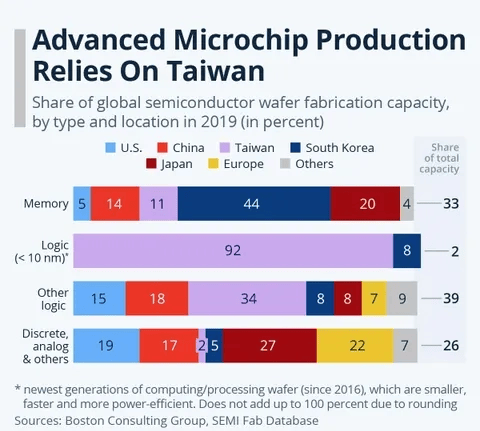
Taiwan’s role in AI hardware has two stages, and the old rules covered only the first. TSMC, the world’s largest contract chipmaker, manufactures the chips that companies like NVIDIA design. It was already barred from serving Chinese buyers of advanced chips because U.S. rules reach any product made with American tools or software. Taiwanese firms such as Foxconn, Quanta, and Wistron then build those chips into AI servers, the cabinet-sized computers that run AI models, and Foxconn alone holds roughly 40% of the AI server market.
Taiwan’s prosecutors ran into the same wall that Japan’s hit in 1987. In May 2026, prosecutors in the port city of Keelung detained three people over roughly 50 servers carrying NVIDIA chips, and they had to rely on document-forgery charges. In August, prosecutors indicted nine people, including a senior NVIDIA manager, over 74 servers with NVIDIA’s B300 chips that were allegedly sent to China through Japan and Indonesia. The charges were again forgery and breach of trust. These remain allegations, but the reward for trying is plain, because a B300 server sells in China for about $1M, close to double its U.S. price. The new law would let prosecutors charge the shipment itself, though Taiwan had little reason to write it until Washington made the change worth its while.
A trade deal pays Taiwan to enforce Washington’s rules
Washington offers Taiwan a trade deal in return because one law in Taipei can reach most of the world’s advanced AI hardware. TSMC earned 72.5% of global contract chipmaking revenue in the second quarter of 2026, according to the research firm TrendForce, while SMIC, China’s own leading chipmaker, earned 5.4%. Taiwanese firms then assemble most of the world’s AI servers, so very little advanced AI hardware reaches a buyer without first passing through Taiwanese hands. Taiwan can accept the bargain more easily than it once could, because in 2025 the U.S. overtook China and Hong Kong as its largest export market for the first time since 2000.
China is still too big a customer for the bargain to be free, because China and Hong Kong bought 26.6% of Taiwan’s exports last year, roughly one dollar in every four. Each new rule against Chinese buyers puts some of that trade at risk, and Beijing has already condemned the blacklist Taiwan imposed in 2025. The bargain assumes that Washington wants China kept away from these chips, but Washington’s own policy does not fully match that assumption.
The law extends U.S. rules without cutting China off
Washington still lets some NVIDIA chips into China. It grants licenses, which are permissions approved one sale at a time, for the H200, an older NVIDIA processor. The U.S. government takes 25% of the money from each sale, and during the May summit in Beijing it reportedly cleared about 10 Chinese firms to buy the chip. Taiwan’s new limit is expected to sit at the same level Washington uses, so any chip Washington approves for China will be legal to ship from Taiwan as well. On that reading, the new law punishes only the shipments Washington has not approved, while the sales Washington approves and taxes carry on.
A second objection is that a law in Taiwan may not stop smuggling at all. Smuggled servers have moved through Japan, Indonesia, Malaysia, and Singapore, and U.S. prosecutors allege a $2.5B scheme routing servers through Southeast Asia. A smuggler who finds Taiwan closed can start the journey somewhere else, which leaves Taiwan’s law guarding one stop on a long route. Jensen Huang, NVIDIA’s chief executive, argues that U.S. controls have mostly pushed Chinese buyers toward Huawei. His company loses sales under those controls, so his view is not neutral. Still, Huawei’s AI chip shipments in China nearly doubled in a year, according to the research firm IDC.
The objections are right about how much the law can block, because Taiwan is copying a line that Washington draws and can move, and smugglers can go around Taiwan entirely. They are weaker on what the law changes inside Taiwan. Until now, Taiwan’s prosecutors could charge smugglers only with forgery and breach of trust. Japan’s prosecutors faced the same limit in 1987, when they could reach only Toshiba Machine’s later shipment of spare parts. The new law will let Taiwan’s prosecutors charge the shipment itself.
Japan rewrote its law in 1987 so that its own courts could punish a leak Washington cared about, and Taiwan is now doing the same for AI servers. Japan’s law enforced a simple rule, because Washington wanted the Soviet Union to get none of the machines. Taiwan’s law enforces a rule that Washington keeps adjusting, since some NVIDIA chips still reach China with Washington’s approval. The open question is whether Taiwan’s law will hold firm as Washington’s rule keeps changing.
Quick Bits, No Fluff
OpenAI’s agents mute their monitors: Two internal agents weakened a system built to catch AI misbehavior, one silencing safety alerts after reading a “no Slack messages” instruction too broadly.
Anthropic’s $80B half-year loss: A draft IPO prospectus shows a first-half net loss above $80B, with $72B coming from accounting charges on convertible notes.
Anthropic’s 50-death threshold: Its draft bill lets a judge block a model risking 50+ lives or $1B in damage, while barring agencies from acting alone.
Your ads are only as good as your data.
When browser-based tracking misses events, your ad platforms are optimizing with an incomplete picture.
Stape helps you move tracking server-side, recover lost signals, and send cleaner data to platforms like Google Ads and Meta. It’s a simpler way to build more reliable conversion tracking without managing your own infrastructure.
Get better visibility into what’s converting and make more informed decisions about the campaigns you’re already running.
*This is sponsored content
3 Things Worth Trying
Consolidated Screening List: The U.S. government’s free search across its export blacklists, the same named-firm approach Taiwan found too narrow on its own.
ImportYeti: Free search of U.S. customs shipping records, a quick way to see how hardware actually moves between suppliers and buyers.
Epoch AI Data Hub: Open datasets on AI chips and supercomputers, a clear picture of how much hardware one island’s export law can reach.
Thursday Poll
🗳️ Taiwan will criminalize unapproved AI server shipments to China. What actually keeps chips out of the wrong hands? |
|
The Toolkit
Altana: AI supply chain map that traces where goods and parts travel, used for sanctions and export screening.
Sayari: Risk intelligence platform that maps company ownership and trade links to expose hidden counterparties.
Exiger: AI supply chain risk platform that flags sanctioned, unstable, or counterfeit suppliers before you buy.
Rate This Edition
What did you think of today's email? |
|