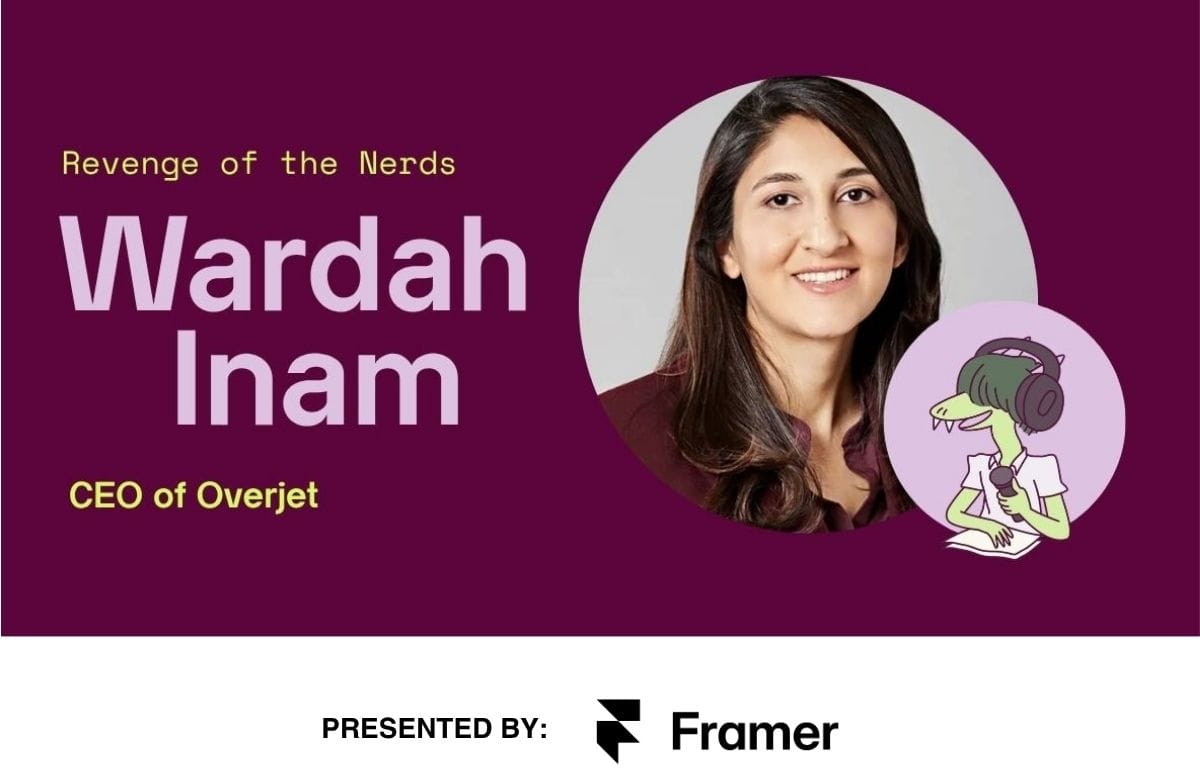
Inside Overjet's Push to Bring AI Precision to Dentistry With Wardah Inam
Welcome to Revenge of the Nerds. We’re skipping the hype and going straight to the builders. In this edition, we talked about:
Wardah Inam spotted the potential of deep learning early, back when ImageNet was proving that computer vision could improve fast, and bet her career on applying AI to real-world problems.
At Overjet, she's built FDA-cleared technology that helps dentists detect disease with precision and deliver clearer, more confident care to patients.
Now entering a major product year, Overjet is expanding into voice AI, insurance verification, and 3D imaging, moving toward a future where the entire dental workflow runs on intelligence, not paperwork.
Let’s dive in. No floaties needed…
Launch fast. Design beautifully. Build your company's website on Framer.
Framer helps teams design, build, and launch their marketing sites lightning fast. With the ability to publish hundreds of CMS pages in a single click, operate at a global scale with seamless localization, and even host unified content across multiple domains, teams have never been able to ship faster.
*This is sponsored content
Revenge of the Nerds
Wardah Inam, CEO of Overjet
Wardah is CEO of Overjet, where she's using AI to bring objective, data-driven standards to dental care at scale.
She got hooked on AI during the early deep learning wave, when ImageNet showed that computer vision wasn't just improving, it was improving fast. The models were getting bigger, the data was getting richer, and the applications were getting real.
After studying at MIT, Wardah founded Overjet in 2018 alongside researchers from MIT and Harvard, with a clear thesis: dentistry needed an objective standard for clinical decision-making, and AI could be that standard. Seven-and-a-half years in, she's still hands-on and diving deep wherever the company needs her most.
What was it about the early deep learning wave that made you decide this was the field?
When ImageNet came out, I could see that computer vision was not only performing well but improving at an incredible pace. Looking deeper into deep learning, it just made sense. The models were going to get bigger, the data was going to grow, and the capabilities were going to keep getting better.
What really attracted me was the idea that we could solve real-world problems using data. That felt like a meaningful direction, not just an academic exercise.
Overjet started with you wearing every hat. What was the hardest job to let go of as the company grew?
Honestly, letting go has not been hard for me. The things I hold onto longest are the ones where I haven't yet found someone who is better at them than I am. But the good thing is I can hire specialists who are really good at each piece.
Once there is someone who can take something on, it's easy for me to step back. I'm always involved anyway—I'm not hands-off. But depending on where things stand, I either dive deeper or, if there are no problems, I stay out of the way.
You have had a long-term roadmap since 2019. What has stayed constant in that vision, even as the technology changed?
Using AI to provide more comprehensive, better care while reducing cost. That was the core idea from the beginning, and it has remained exactly the same.
Dentistry doesn't have strong interoperability standards. What single standard would make the biggest difference?
The standards actually exist, the issue is that they don't get used. Interoperability standards are incredibly important because they can speed up development and help companies get to market faster. If the industry simply adopted what's already out there, it would make a real difference.
You're already using tools like Cursor & MCP workflows internally. Where has AI improved speed without hurting quality?
I don't think AI hurts quality at all. It's helping across the board. Our IT team responds to tickets much faster now. Our marketing team can do more than they ever could before, like directly updating the website, putting things into the product that they weren't handling previously.
We use a tool called Serval for IT automation, Claude Code and Lovable for the marketing side, and AirOps for other workflows. There's no trade-off between speed and quality here. You can have both, and it's only getting better.
AI adoption feels fast inside the Overjet bubble, but the industry is bigger than that. How do you reach dentists who never show up online?
We use direct mail. We know their addresses and they're physically present at their practices, so we can send them something tangible they'll actually see. Beyond that, it's about physical advertisements rather than digital ones. Not every audience lives online, and you have to meet people where they are.
You've framed your product strategy around giving time back. Which workflow do you most want to eliminate entirely for dentists?
Administrative workflows, specifically revenue cycle management. Dentists spend a huge amount of time on that side of the business, and it should be made significantly easier. That's where the biggest time savings are waiting.
2026 is shaping up as a major product year—voice, credentialing, CBCT, & RCM. Which bet will create the biggest step change?
It depends on the outcome you're measuring. For patient outcomes, the biggest impact comes from our diagnostic and vision AI. We have something called the Oral Score that measures a patient's oral health and then identifies what treatments are needed based on the disease and its extent in the clinical data. That ability to detect, measure, and guide treatment is already having a major impact, and it will only grow.
But if you're talking about saving the dentist's time, voice AI is the game-changer. And if you want to save staff time, our insurance verification product can take a massive load off the office manager. Different products, different use cases, different outcomes.
What is Overjet most excited to do in 2026?
I'm excited to get the Oral Score into the hands of patients so they can start being more proactive about their oral health. And beyond that, finding ways for oral health to improve overall health is something that really excites me.
The mouth is connected to everything, and we're just starting to unlock what that means.
Additional Reads
Be the future of AI
Hunting for AI roles eats hours. Careers pages, group chats, internal referrals, a dozen job boards.
The Athyna AI Job Board does the watching for you. We track openings at frontier AI companies, match them to your profile, and notify you when a role hits a 75% matching index.
*This is sponsored content
Quick Poll
🗳️ Wardah Inam says dentistry has relied on subjective interpretation for too long. What’s the smarter bet for clinical decision-making? |
|
Rate This Edition
What did you think of today's email? |
|







.svg)
.svg)